
Reading the substrate tested stories about conflicts against the working system they take hold in. It looked back. The harder question is whether the substrate can say anything useful about what comes next.
It can show which limit Russia is closest to hitting. It cannot show when, or what its leaders will do then.
Russia is a good test, because it is so often explained through one man: what Putin wants, and what he will do next. That says what Putin might want, not what Russia can afford. What Russia can afford is set by part of the substrate: its oil money, its budget, its factories, its ports, and how the people who pay for the war react. Leaders belong to the same system. They choose among the options these limits leave. The limits show which options are getting harder to sustain.
Slower than speeches
These limits change more slowly than decisions. Speeches, doctrines, elections and personalities can change in weeks. Oil revenue, industrial capacity, logistics and demography move over quarters and years. The slow ones decide which options a leadership has left, so they are the ones to watch. But a limit that tightens over years can be resisted for years. The measures show which limits are tightening.
Six measures cover most of these limits. The figures below date from late 2025 to September 2026.
Mates’ rates
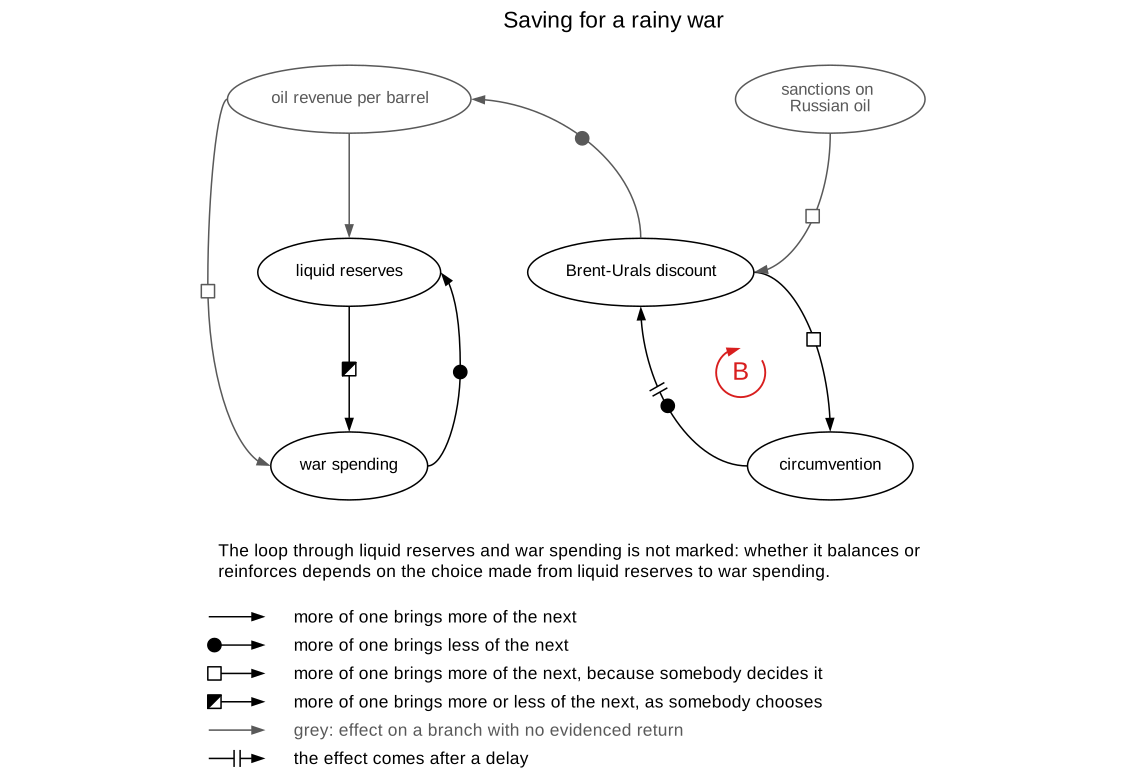
Oil revenue is the main measure. It pays for the war and for the spending that keeps the war tolerable at home. The number to watch is not the headline oil price but the discount on Russian crude and the cost of the shadow fleet that carries it. Sanctions on Russian oil have cut the price Russia gets more than the amount it sells. On the same figures, the gap more than doubled between October and December 2025, after new sanctions. After the 2023 price cap and the EU embargo, Bruegel found, a wider gap lasted only until circumvention spread. Export value reaches the budget only indirectly, because Russia taxes extraction. Brookings puts the government’s share at about half. When Russia earns less per barrel while selling as much, Russia’s money shrinks with no single moment to mark it. This may be the measure that most decides how long Russia can pay for the war.
Saving for a rainy war
Behind the oil sits the money the state can draw on: the liquid part of the sovereign fund, what it can borrow, and the deficit it can run. Together they decide how long Russia can cover its deficit. Bruegel’s December 2025 assessment finds that Russia can probably fund the war at least through 2026. It can raise taxes, cut other spending, borrow more and draw down what is left of the fund. But “all these fiscal adjustment measures have their obvious limits”. Even under repression, Bruegel adds, “the social tolerance of higher taxes and spending cuts” may not be unlimited. Economists call it fiscal adjustment. Households receive it as a bill.
Some assembly required
Components limit modernisation. Precision weapons depend on microelectronics, optics and machine tools, and Russia makes too few of its own. Chatham House’s 2025 study of the Russian defence industry finds factories swapping in lower-quality, less sophisticated parts, and faulty systems causing accidents and misfires. Russia relies heavily on Chinese components of lower quality than the Western ones they replace. Import substitution has, in its way, succeeded. The imports now come from China. It follows a “retain-and-adapt” approach, which fits new technology “directly into proven, older-generation systems”. Chatham House expects the industry to keep producing systems “good enough” to pose a sustained threat to Ukraine. The shortages mean worse weapons now. Later, they may stop Russia building an army that can match NATO or China.
The provinces pay
Manpower depends on how people react to recruitment. Only so many men can be taken from Moscow and St Petersburg before a leadership risks protest, and casualties shrink the pool. Moscow and St Petersburg are cities the Kremlin “has long tried to shield from the trauma of front-line losses”, the Kyiv Independent reported. Ilya Ponomarev, a former lawmaker now in exile, told the paper: “It’s the capitals where revolutions may happen.” Recruits and casualties from the two cities are rising. Experts still expect most of the burden to fall on the provinces, which avoids a politically dangerous mass protest “at least for now”.
A weapon with customers
Export leverage is what Russia can do to others. Grain, fertiliser and energy can each be used to pressure the countries that depend on them. It is the only one of the six that measures pressure on others rather than a limit on Russia. From 2022 to 2023, War on the Rocks notes, Moscow used the Black Sea grain corridor as leverage, and war-risk insurance for Black Sea shipping spiked. It is not clear how far Russia can use these without damaging its trade with China and India, which buy its discounted crude.
One base left
Logistics and geography set where force can be sent and held: the Black Sea and the choke points. This is the slowest measure to change, because bases and supply lines take years to replace. Under the Montreux Convention, Turkey keeps the Bosporus and Dardanelles closed to warships of the countries at war. Ukrainian attacks in 2023 and 2024 forced most of the Russian fleet to withdraw to Novorossiysk. In April 2026 Carnegie called Novorossiysk Russia’s only fully functional naval base in the Black Sea.
2026
Then came the war with Iran. Since the American and Israeli strikes on Iran began, CREA estimates, higher oil and gas prices have earned Russia about $36 billion more from seaborne exports in six months. In September the discount on Russian crude was still about $23 a barrel, as wide as after the late-2025 sanctions, but taken off a much higher price. Some of Russia’s best economic news of 2026 came from someone else’s war.
Falsely flagged tankers have fallen by more than half in a year, and the largest flag in the shadow fleet is now Russia’s own. The shadow fleet has stopped bothering with the shadow.
As of September 2026, none of the six measures yet forces Russia to scale back the war. Money came closest in late 2025, and higher prices have since eased it. Components make Russia’s weapons worse, but do not stop it fighting. Manpower holds as long as most of the burden falls on the provinces. If oil prices fall back while the discount stays wide, money becomes the limit first. If recruitment reaches the capitals, manpower does.
In October 2026 the United States eased the pressure on Russia’s money. A Treasury licence lets Russian diesel into the United States until April 2027. A week later an executive order waived most of the new sanctions and tariffs Congress had passed against Russia, including tariffs on the countries that buy most of its oil and gas. The order leaves the earlier sanctions in force. The figures above predate both decisions. The licence lets Russian diesel be sold into the United States, and the waiver lifts tariffs that had not yet applied. CREA expects Russia’s fuel export earnings to stay low in October all the same.
Dispositions may vary
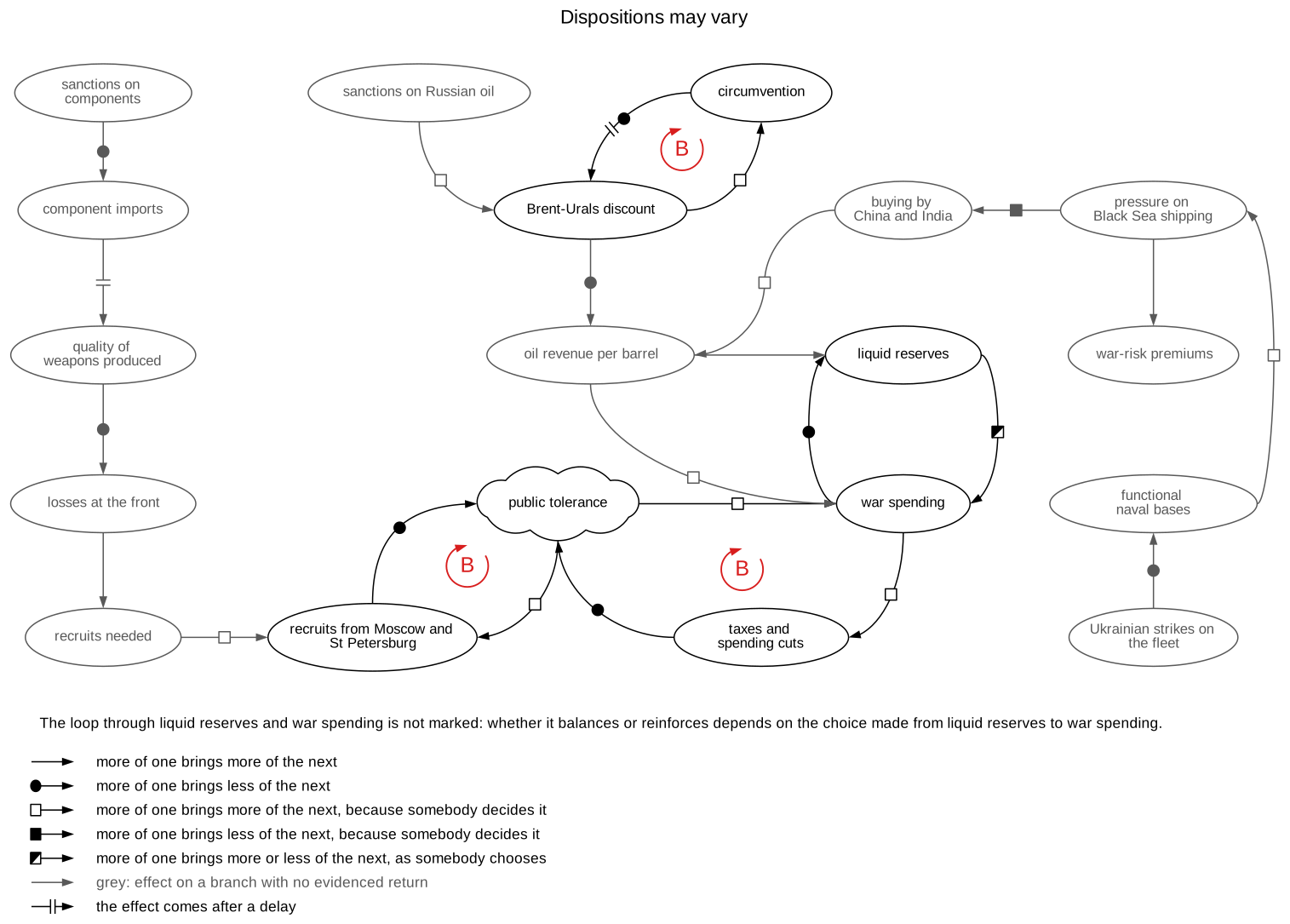
The same tightening can produce opposite responses. One leadership sees the limit coming and holds what it has and waits. Another expects time to work against it and spends its reserves on a gamble to win before the limit tightens further. Which one a leadership does depends on how much risk it will take, and how long it thinks it has.
A leadership will put up with a great deal of economic pain before it accepts the kind that threatens its hold on power. That is why sanctions have not forced Russia to stop. An economy can struggle for years while the regime stays in place. Regimes have always been touchingly loyal to themselves.
Small print
The figures behind the measures move faster than the limits themselves. The oil discount can change in a week, so each figure needs the date it was true. A forecast built this way stays a guess. It is only a better-informed one.