GNU Terry Pratchett
The village of Arkos sits in the hills behind Ephebe, where the land goes up in steps and the goats go up faster. It has forty-one houses, a well, a shrine to a small god of small mercies[1], and one of everything else. For four hundred years nobody outside the hills held any opinion about it. Then a geologist from Ankh-Morpork found grey salt under the top pasture, and Arkos acquired opinions from all over the Disc.
The salt made the glass jars of the new clean lamps hold their light three times as long. Ankh-Morpork wanted clean lamps very much, having spent several centuries finding out what the alternative did to the air. The Ankh-Morpork Clean Light Company bought a licence from the Tyrant’s office in Ephebe and printed a prospectus. The prospectus described the top pasture as empty. This was true in the way prospectuses are true.
There were no shareholders on it.
Arkos objected in the Ephebian manner, at length and with footnotes. Kyria Ourania Gallo, who kept sixty goats and most of the village’s memory, sat in the Tyrant’s waiting room for three days. Her nephew Stavros, who had been to school in the city and could argue in the philosophical style, wrote petitions, signed them with his name and his house, and sent a copy to the Ankh-Morpork Times. The Tyrant’s office acknowledged every petition, in the order received.
⁂
The League of Friends of the Ephebian Hills was founded on a Tuesday evening in the upstairs room of a coffee house on Broad Way, by eleven people who had read the item on page seven of the Times and felt it in their chests. Miss Clarinda Swithe took the chair, because she had brought the biscuits. Mr Rupert Glover-Pargeter, who painted banners for pleasure and had waited most of his life for a cause that deserved one, offered his brushes.
Young Mr Tobias Wix offered his Dis-organiser. It had an imp in it that could paint iconographs and keep appointments, and did both with more enthusiasm than accuracy.
Their hearts were entirely in the right place. So were the hearts of most people who have done serious damage in the world, and the League’s stayed there to the end.
Nobody in the room had been to Arkos. Nobody in Arkos had heard of the room. The League considered writing to ask what Arkos wanted, and decided that a letter took three weeks by boat, and the goats might not have three weeks. Something had to be done. Printing was something.
⁂
The pamphlet came off a press in Gleam Street the following Monday, and everyone agreed it was very moving. Its cover read:
On the back page the League reprinted Stavros’s petition in full, all twenty-six signatures, each with its house, under these words:
The pamphlet sold four hundred copies in Ankh-Morpork, which pleased the League. Three copies reached Ephebe on the next boat. The League did not know this. One went to the Tyrant’s office. One went to the Clean Light Company’s site office at the foot of the hill road. One went to a man on the Ephebe docks who did odd jobs for whoever paid, and could read an address, if not much else.
Arkos received a great many letters. The ones from Ankh-Morpork were kind, addressed to the brave goatherds, and read aloud at the well. The others were not read aloud, and were not signed. Stavros’s mother, who had signed nothing, received two. His sister in Tsort received one, on account of the surname.
In the fourth week somebody came at night to the pen behind Kyria Gallo’s house and killed nine of her goats. In the hills only the neighbours know which house is whose. Now so did the back page of a pamphlet. Nothing else was touched.
Nothing else needed to be. In the hills a goatherd’s goats are not property in the Morporkian sense. They are the part of the goatherd that lives outdoors.
⁂
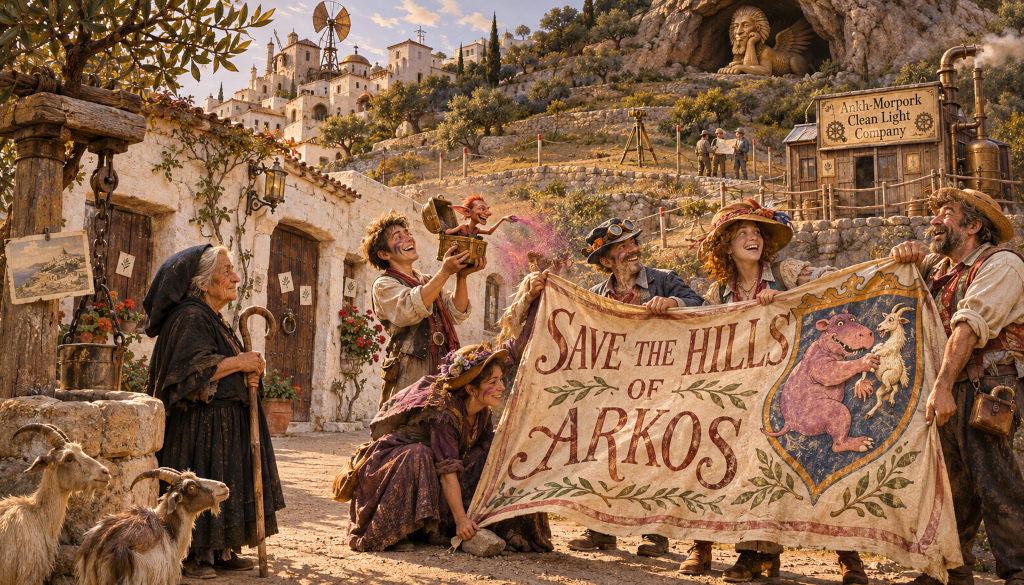
Mr Glover-Pargeter’s banner was the finest thing he had ever painted. It was twelve feet long and read:
Under it, because a banner ought to say who stands behind it, he painted the League’s crest: the hippopotamus of Ankh-Morpork, rampant, holding a goat in a manner intended to be protective.
The League shipped the banner to Arkos with a donation of forty Ankh-Morpork dollars, by postal order in Stavros’s name, so that there could be no mistake about who it was for. There was no mistake.
The Ephebian Voice printed the banner on its front page, with the postal order reproduced beside it, under the headline:
The so-called goatherds of Arkos, the Voice explained, opposed the mine for money: foreign money, from a foreign city with a long history of wanting things that belonged to Ephebe. The last part was true, and did a good deal of work for the rest.
The Clean Light Company was also from Ankh-Morpork. The Voice did not mention this. In the Voice’s view it was not the same kind of foreign.
Within a fortnight paper stickers appeared on front doors in Arkos. They read AGENT OF A FOREIGN CITY LIVES HERE. On Stavros’s door someone had added MONEY-LAUNDERER in a different hand, which was held locally to show initiative. The Tyrant’s office drafted a Law on the Registration of Persons Assisted From Abroad, and it passed on its second reading.
The League read about the law in the Times and sent the Tyrant a strongly worded letter, on League paper, with the crest.
⁂
In spring the Clean Light Company began to bring its carts up the hill road, and Arkos sat down in it. Sitting in a road is an old Ephebian practice, older than the Tyranny, and it had always cost a fine of about the price of a goat.
The League sent six members by boat to stand with Arkos. They arrived with the banner, a hamper and the Dis-organiser, whose imp painted everybody on the road, faces to the front, for the League’s newsletter. They stood in the road for two days and sang. Kyria Gallo said afterwards that they were very nice people, and that the young one could carry a goat properly, which few townsfolk can.
On the third day the Tyrant’s guard came up the hill road. The six members of the League were put on the next boat to Ankh-Morpork, with their papers stamped DEPORTED and a letter saying they were not to come back. They found this tremendously exciting. Mr Wix’s account, “Deported!”, ran to four pages in the newsletter, with iconographs.
The price of sitting in a road had gone up while nobody was looking. Stavros and four others from Arkos were charged with endangering life, sabotage of a licensed enterprise, and sedition. They were released to await trial on condition that they did not associate with any other person involved in the protest.
In a village of forty-one houses, this meant that Stavros could not speak to his mother, his neighbours, his cousins, the priest of the small god, or most of the goats.
He lost his place at the olive press the same month. The owner of the press was very sorry. The owner of the press had a licence coming up for renewal.
One more thing went wrong, and nobody found it out for a year. The imp in Mr Wix’s Dis-organiser kept a diary, as imps are made to, and the makers sold the diaries by the thousand, without names, to anyone who wanted to know where people went[2].
The diaries said that a member of the League had spent two hours in the house with the blue door, an afternoon in the house behind the shrine, and a night at the farm by the top pasture. None of those houses had signed the petition. Afterwards, all of them had stickers.
⁂
The League held a welcome-home evening at the coffee house on Broad Way. The imp’s iconographs were pinned round the walls, forty faces from the hill road, with a name under each one the League knew, and the League knew most of them. Mr Glover-Pargeter proposed a vote of thanks to the brave people of Arkos, and it passed unanimously.
The brave people of Arkos were not present. At least five of them were forbidden to be in the same room as each other.
A postcard went to Arkos the following week. It showed the Brass Bridge at sunset, and on the back, in Miss Swithe’s round hand, it said:
Kyria Gallo pinned it up by the well. Nobody in Arkos could say afterwards whether she meant it kindly. She was not a woman who explained herself to postcards.
In summer the League invited Stavros to speak at the Great Exhibition of Clean Light in the Guild of Merchants’ hall. The terms of his release did not let him leave Ephebe, so Kyria Gallo went instead. She sat in the third row for two days. Nobody had put her on the programme. The chairman of the Clean Light Company spoke for an hour about the empty hills. When she got home, her door had been broken and her well filled with stones.
⁂
The first person from outside who asked Arkos anything was a field worker from the Home for Bewildered Beasts of Legend. The Home had a chapter in Ephebe and had been visiting Arkos twice a year for a decade, on account of the sphinx. The sphinx lived in a cave above the top pasture, had retired from riddles, and lay directly in the path of the company’s second shaft.
The field worker came on foot and left her Dis-organiser at home, because the Home had learned something about imps the year before[3]. She sat at Kyria Gallo’s table and asked what Arkos wanted, and who wanted to be named, where, and when. She wrote the answers down, and asked again the next morning in case anyone had changed their mind. It took two days.
Kyria Gallo was so surprised to be asked that she answered.
Her list went to Ankh-Morpork in the field worker’s luggage, by hand, because the Home had also learned something about the post. It said:
Under the list she had written a line of her own. People from outside break what they do not understand, or they help it. It comes to the same bill.
⁂
The Ankh-Morpork Clean Light Company kept its head office on Broad Way, four doors down from the coffee house where the League had been founded. Nobody in the League had noticed. It is very difficult to see something four doors away when the problem is in the hills behind Ephebe.
On the first Tuesday of the next month the League stood outside it. Mr Glover-Pargeter painted a new banner, naming the company, its chairman and its licence, and all eleven members signed it with their own names. They were in Ankh-Morpork, where the Watch knew them, the Patrician tolerated them, and their mothers lived round the corner. Every risk on that pavement belonged to someone who would sleep at home that night.
The banner did not mention Arkos.
A lawyer from Ankh-Morpork wrote to a lawyer in Ephebe. The flour went on the next boat, with no name on the sack.
Arkos, its people, the League and the Clean Light Company are invented. Ankh-Morpork, Ephebe, the Times, the Patrician, the Watch, iconographs, Dis-organisers, imps and small gods belong to the Discworld of Sir Terry Pratchett and his estate, and appear here with gratitude, without affiliation and without commerce. The Home for Bewildered Beasts of Legend is borrowed from Defence blues.
Most of what goes wrong in Arkos has happened to environmental defenders in Europe, who reported it to the UN Special Rapporteur on Environmental Defenders (key trends, regional consultations). Kyria Gallo’s last line is borrowed from Nemonte Nenquimo, who told Grist that outsiders “either destroy what they don’t understand or they try to help what they don’t understand”.
-
On the Disc a god is as large as the belief in it. A god of small mercies, believed in by forty-one households, is about the size of a sparrow, and keeps to the shrine roof. ↩
-
The makers described the diaries as anonymous. Each page was. The books were not. ↩
-
At some expense, and mostly from a journalist. ↩