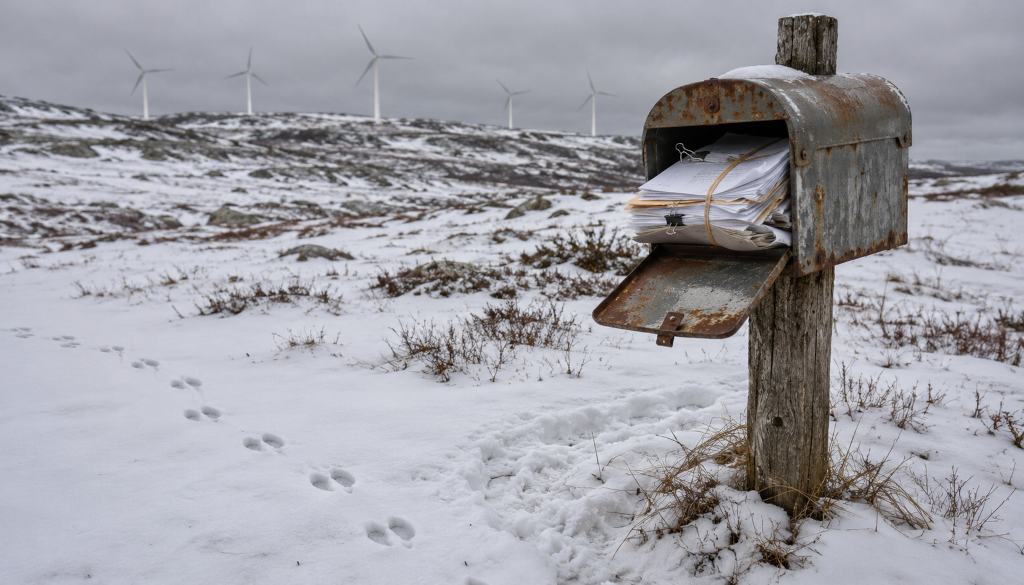
On the Fosen peninsula in central Norway, the Storheia and Roan wind farms stand on winter pasture used by Sami reindeer herders. Reindeer avoid the turbines, leaving parts of the pasture unusable. In October 2021, Norway’s Supreme Court invalidated their licences. It ruled that the licences violated the herders’ right to enjoy their own culture, protected by Article 27 of the International Covenant on Civil and Political Rights. The turbines stayed.
In northern Portugal, residents of Covas do Barroso oppose a proposed open-pit lithium mine. In October 2026, they formed a human chain in front of Savannah Resources’ machines to block its lithium prospecting. Nelson Gomes, of the residents’ association Unidos em Defesa de Covas do Barroso, told local radio that residents would bear the consequences of the mine. They had been fighting it for almost ten years, he said, to keep their way of life and the forests of a region classified as World Agricultural Heritage.
The people who live with these decisions did not make them. The licences at Fosen were issued in Oslo. The environmental approval for Barroso came from Lisbon, and its priority from Brussels. Each of those offices can be addressed and written to.
“The matter must be thoroughly assessed again”
When the Norwegian government apologised to the Fosen herders in March 2023, a year and a half after the ruling, it added: “The matter must be thoroughly assessed again.” The Supreme Court had ruled the licences invalid but had not ordered the turbines removed, so what happened next was up to the energy ministry. In April 2023 the ministry started mediation.
In December 2023 and March 2024, the two Sami herding groups at Fosen settled with the wind farm companies. Sor-Fosen sijte agreed with Fosen Vind and Nord-Fosen siida with Roan Vind that the turbines could operate until their current licences expire. In return, the herders got money for reindeer-herding measures and a veto over renewing the licences, and Norway took on the job of finding additional winter pasture outside Fosen.
When Sor-Fosen signed, its leader, Leif Arne Jama, said, “Now it’s up to the politicians to ensure that this doesn’t happen again.” In March 2024 the Energy Ministry said the Roan agreement protected the herders’ rights, and ended its review of that licence.
“An additional area”
The new pasture is to be ready by December 2028. The agreements, and the minister’s answers in the Storting, call it an additional area: “tilleggsareal”.
“Additional”, that is, to the pasture at Storheia and Roan, which the Court of Appeal found the reindeer avoid so thoroughly that it “must be considered lost as pastures”.
Norway is considering Hammalsfjellet-Salekinna as a possible site. Both groups support further study of the area; the government has not decided whether to use it.
In its response to the public consultation, the Innlandet county board of KS, the association of Norway’s municipalities and counties, advised against using the site, citing local control, farming and wild reindeer. The board said a solution could not shift the burden onto other communities, industries and nature that were not part of the original conflict.
The agriculture minister answered a written question three days after the consultation closed. If the government chose the site, it would first try to reach voluntary agreements with the landowners. The minister believed that taking land from owners who did not agree would need a special law passed by the Storting.
The question came from Anna Molberg, a Conservative member of the Storting. She had asked whether the state would take the land if the owners did not agree. She called the site “erstatningsareal”. A replacement area.
“Not visible as a company”
In 2020, Society for Threatened Peoples Switzerland complained about BKW, a Swiss investor in Fosen Vind, to the Swiss National Contact Point in Bern, where BKW has its headquarters. A National Contact Point takes complaints under the OECD business guidelines about companies based in its country, wherever the harm is. The group said BKW had failed to check how its investment affected the herders’ rights.
After mediation, BKW updated its conduct code and strengthened its human-rights checks for energy projects. The code refers to free, prior and informed consent for vulnerable groups, and BKW agreed to raise these standards with business partners.
BKW would not open its whistleblowing system to everyone its projects affect. Its reason was that most of its energy projects sit in separate companies in which BKW “is generally not visible as a company”. In its 2022 follow-up report, the Contact Point answered that in joint projects BKW should use its leverage to get its partners to provide for remedy, and said BKW had taken steps to carry out the agreement. Those steps did not give the herders new pasture or remove the turbines.
“Some computer bug”
In 2021, the environmental group Fundacao Montescola asked Portugal for the Barroso mine files. The environment agency said they would be released when the consultation on the mine’s environmental assessment opened. The geology directorate, which held the files, sent Montescola to the agency’s website.
When the consultation began, several documents would not open for the first 20 days. The agency called it “some computer bug”. MiningWatch Portugal filed screenshots of the server errors.
The Aarhus Convention gives people rights to environmental information and a say in decisions that affect the environment, and its Compliance Committee in Geneva checks whether governments follow those rules. Montescola asked the Committee to examine Portugal’s handling of the mine. In its 2025 findings, the Committee found that Portugal could not hold back a completed report until the consultation opened. The authority holding the files had to answer Montescola’s request itself. And the documents had to be accessible from the first day of the consultation.
The findings came four years after Montescola’s request. The Committee also rejected Montescola’s argument that options were already closed by the time the 2021 consultation began.
“Ten working days”
In 2023, a revised environmental assessment and mine plan went out for consultation. Residents trying to challenge the plan had ten working days to make sense of its 1,776 technical files. Two days in, Montescola asked in writing for at least 60 days. The agency refused within the week, citing the law: extending the deadline risked the revised documents being approved by default.
The refusal went into the file in Geneva. Ten working days, the Committee found, was far too short, and the longer consultation of 2021 did not make up for it. It also found that the law itself broke the Convention’s requirement of a reasonable time to participate. The Committee recommended changing the law and the practice.
Portugal’s environment agency had approved the revised assessment in May 2023, with conditions. The Committee’s findings did not cancel that approval or stop prospecting.
“Strategic”
In March 2025, the mine the residents had been fighting for years became a European priority. The European Commission named it a strategic project under the Critical Raw Materials Act, which gives it priority in the permit process and a deadline of 27 months for a permit that involves extraction. The label does not authorise mining. Portuguese authorities still decide whether to grant permits.
Unidos em Defesa de Covas do Barroso and the environmental law charity ClientEarth asked the Commission to reconsider the label. The Commission refused. In February 2026, the residents’ association and ClientEarth challenged that refusal in the EU General Court. They are asking the Court to annul that refusal, not to cancel Portugal’s environmental approval.
Last known address
The General Court has not ruled on Barroso. The Fosen herders are still waiting for the winter pasture promised by December 2028.