Ankh-Morpork has a river, in the sense that it has a long thing through the middle that is called one. The Ankh is the only river on which a body’s outline can be chalked, and most years it can be walked across by any citizen with no further plans for their boots. Upstream, the tanneries and Harry King’s yards put things into it. Downstream, the Shades take them out again, mostly by drinking. Between the two sits the Patrician, who sets the dredging. He does not do this out of feeling for rivers. He does it because a city whose river has set solid stops paying its taxes, and because the alternative, a river that runs clear, is the kind of thing that gives people ideas.
Most years the Ankh flows, after a fashion. The dredging is cut a little, the river runs a little slower, nobody minds. Then one spring it sets, the way a jelly or a mortar mix sets: it stops being a liquid and becomes a solid that holds its own shape, with nothing added, by standing. Carts cross it. The Patrician restores last year’s dredging and nothing happens, because the muck is now holding itself up. He restores the dredging of ten years ago and nothing happens either. The way back is not the way in. Outside the city that shape has a name, the fold, and the people who study lakes have tools for asking how close a river is to it. The tools do not care what a river is made of.
The loops below model how the city keeps making the river thicker. The question here is nastier: what happens when they run long enough that the river acquires more than one place to rest, and then loses one.
Three loops
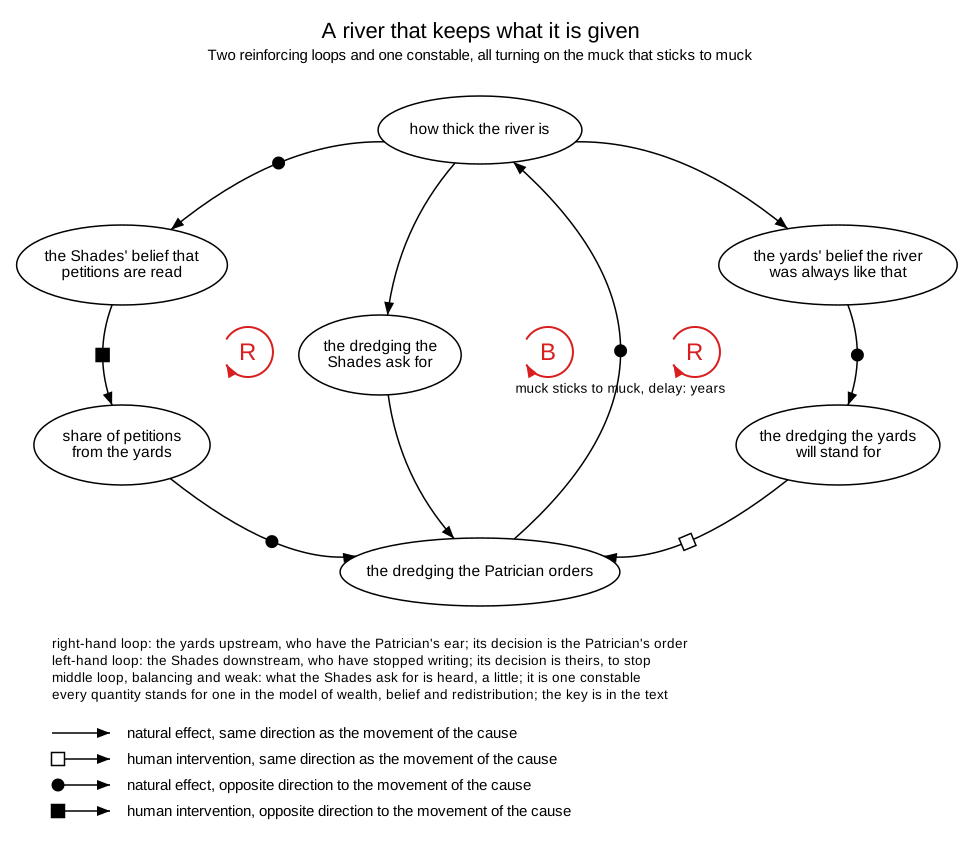
Three loops run through the city, and they share one edge, which is the model’s rule for the river: muck sticks to muck. A thin river carries a dead dog to the sea. A thick one keeps it, and the dog becomes part of the river’s holdings, on which it earns more dog. So less dredging leaves the river thicker, and the thicker it is, the more of next year’s dumping it keeps.
The right-hand loop is the yards. The men whose outfalls drain into the Ankh concluded long ago that the river was always like that, and that they, having prospered beside it, are the sort of people who deserve to. The thicker the river, the firmer that belief. The firmer the belief, the less dredging they will stand for. And what the yards will stand for is what the Patrician orders, because they have his ear and the Shades do not. Two of its four edges run against their cause, which is an even number, and an even number of opposites makes a loop feed itself. The one decision in it is the Patrician’s order, the open square on the edge into it.
The left-hand loop is the Shades. They concluded that petitions go into a box in the Palace which is emptied into the river, which is true, and the thicker the river the more certain they are of it. The less they believe a petition is read, the fewer they write, so of the petitions that reach the Palace a larger share come from the yards. The Patrician reads the petitions he receives. So the dredging is ordered for the yards’ benefit, which is to say less of it, and the river thickens, and the Shades are a little more certain. Four edges against their cause, still even, still feeding itself. Its decision is the Shades’ own, the filled square: to stop writing.
The middle loop is the one constable. The thicker the river, the more dredging the Shades ask for, and what they ask for does raise what is ordered, by the amount of one constable sent from Pseudopolis Yard when the smell arrives, who dredges a bit and goes home. One edge against its cause, an odd number, so this loop pulls the other way. It balances. It is one constable.
The river’s bookkeeping
Each year the Ankh’s change is the difference between what is dumped into it and what is dredged out, multiplied by how thick it already is, because muck sticks to muck. Written down, the river’s change in a year is:
$$\Delta \text{thickness} = \bigl(\text{dumping} - \text{dredging}(\text{thickness})\bigr) \times \text{thickness}$$
The loops are not the equation. They are what gives the dredging its shape. Dumping is fixed in the model and takes no interest in the river. Dredging is not fixed. The Patrician sets it, and the three loops set the Patrician, so together they make the dredging a function of the thickness itself, which is why it is written as dredging of thickness, and the river’s change is the net difference between what is dumped and what is dredged, multiplied by what is already there. The thicker the river, the richer the yards and the deafer the Palace, so less dredging. The thicker the river, the quieter the Shades, so less dredging. The thicker the river, the more petitions, so a little more dredging, one constable’s worth. Two loops make the dredging fall as the river thickens and one makes it rise, weakly, so on the whole the thicker the river, the less is done about it.
A resting consistency is a thickness at which the river neither thickens nor thins, because what is dumped equals what is dredged. There are two kinds of resting place here: stable and unstable. At a stable one a barge going through stirs the river up and it settles back to where it was. At an unstable one it does not settle back: a little thicker and it goes on thickening, a little thinner and it thins away. The Ankh has a stable slow brown flow, a stable solid, and between them an unstable consistency it cannot hold.
The fold is the spring when the slow flow disappears. Cut the dredging a little each year and the flow gets a little thicker each year, still stable, still settling back after each barge. But the unstable consistency above it creeps down to meet it, and in the year they meet, the flow and the point of no return are the same thickness, and the year after there is no flow left to settle back to. That year is the fold. The name comes from the Patrician’s ledger, further down, in which the line of resting consistencies bends back on itself like a folded strip of paper, and the two creases are the two fold points.
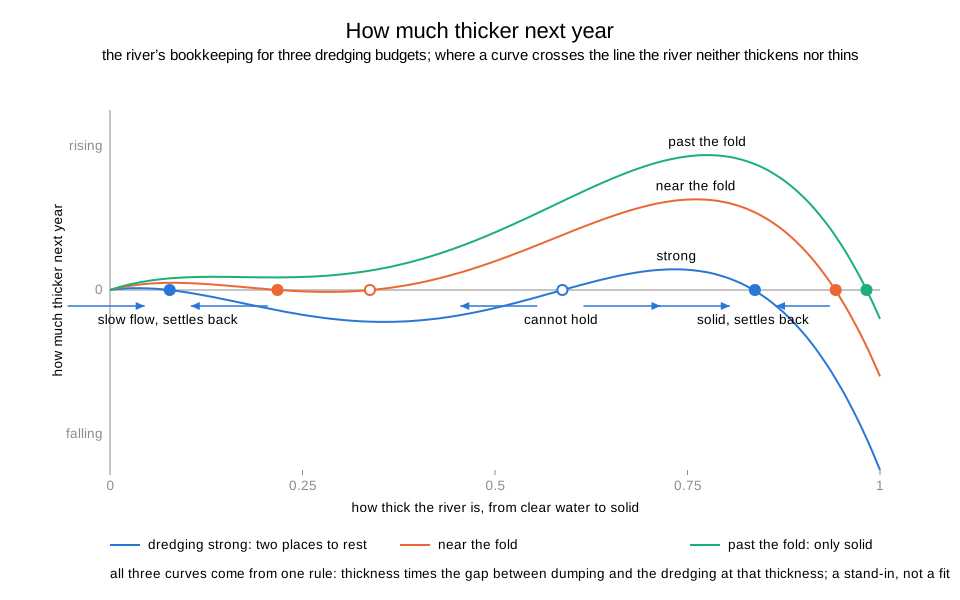
The first picture is the river’s bookkeeping drawn out. Left to right is thickness, from clear water to solid. Up and down is how much thicker the river will be next year, with the grey line meaning no change. Where a curve crosses the grey line the river is at a resting consistency: a filled dot where it settles back, an open dot where it does not, and the small arrows show which way it drifts in between. The three curves are three dredging budgets. On the blue one the dredging is strong: the river has a slow flow to rest at, low on the left, a solid to rest at, high on the right, and an open dot between them it cannot hold. On the orange one the dredging has been cut until the flow and the open dot have almost met. On the green one they have met and gone, the curve never comes back down to the grey line, and every positive thickness climbs.
What this changes is what a cut in dredging is. The same small cut is a nudge on the blue curve, absorbed by the next spring, and on the orange curve it is the step that removes the resting place. Nothing in the size of the cut says which. And the river’s thickness does not say which curve the city is on, because the slow flow looks the same from the bank on all three until it is gone. What tells them apart is the barge, and how long the river takes to settle after one.
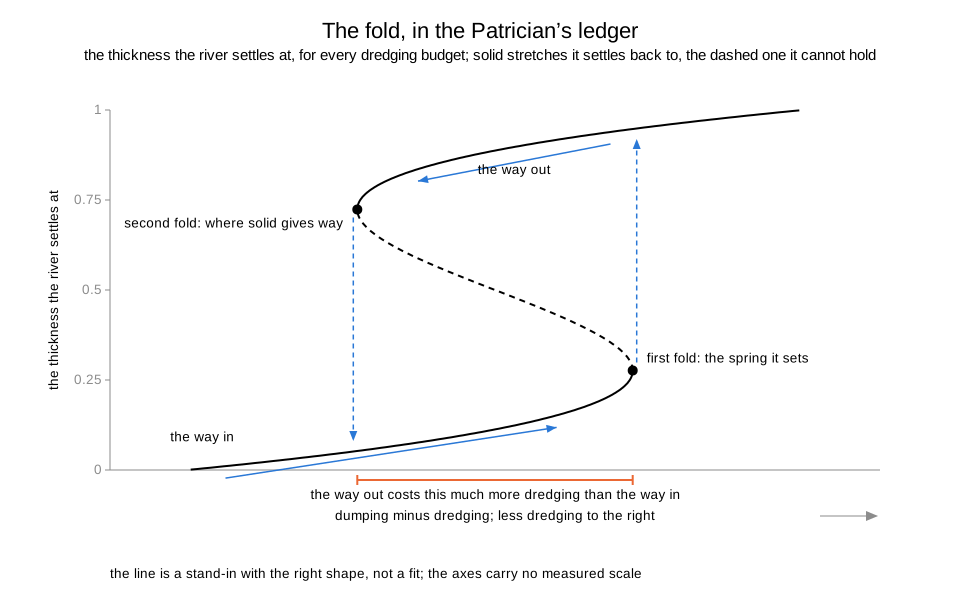
The second picture is the Patrician’s ledger, and the only view that shows the way back. Left to right is how badly the city is losing the argument with its river, dumping minus dredging, with less dredging to the right. Up and down is the thickness the river settles at. The black line is every resting consistency at every dredging budget, and it bends back on itself. The lower solid stretch is the slow flow, the upper solid stretch is the solid river, and the dashed stretch between them is the consistency the river cannot hold, dashed because it never rests there. Follow the lower stretch to the right. The dredging is cut a little each year, the flow thickens a little each year, nobody minds, and at the first crease the lower stretch ends and the only resting consistency left is on the upper one. That spring the river sets. Now walk back. The Patrician restores last year’s dredging, and the river stays on the upper stretch, because the upper stretch runs on to the left past the point of entry. He restores the dredging of ten years ago. Still solid. Only at the second crease, far to the left, where the dredging is so thorough that the Ankh runs nearly clear, does the upper stretch end and the river drop back to flowing. The orange bracket between the two creases is the difference: the way out costs that much more dredging than the way in cost in cuts. The city’s records show the Ankh running nearly clear once, after the great fire, and it was regarded at the time as a disaster.
On a straight line the Patrician could read his position from the thickness. On the fold he cannot: the same thickness sits on the lower stretch on the way in and on the upper stretch on the way out, and they are different places with different futures. A repair sized to the point of entry fails by the whole width of the bracket, which is what it feels like from the Palace when the old dredging is restored and nothing happens. Both pictures are the shape and not the numbers. The axes carry no measured scale, because nobody has measured how hard each loop pulls.
Dredging is what the city does about its river, and the Patrician’s problem is which side of the fold the city is on, not the size of this year’s cut. The river does not tell him, because the Ankh looks the same the year before it sets as the year before that. What tells him is an anvil. In a flowing river a dropped anvil is gone before the ripples close. In a river near the fold it sits on the surface for a week, thinking about it. The time the surface takes to close over a shock is the one reading that changes before the state does.
The physics
The river stands for something, and the something has been worked on. In the world the river stands for, the thickness is the share of wealth held at the top, the dumping is the return on capital less the growth of everything else, and the dredging is redistribution. Bouchaud and Mézard, in 2000, wrote down the simplest economy that could be written: agents whose wealth grows with random multiplicative returns and who exchange with one another at some rate. The tail of the wealth distribution came out as a power law, Pareto’s, without its being put in, and so did a transition. When exchange is limited, in amount or in who trades with whom, the distribution becomes very broad and the economy is dominated by a few individuals; when exchange is favoured, wealth spreads out. They called the first state wealth condensation, after the physics in which a finite fraction of a system’s particles fall into one state, and they noted, less surprisingly in their words, that raising taxes does the same job as favouring exchange. That supplies the Ankh’s physical setting: concentration can be a place the system comes to rest, and exchange or taxation can pull against it, in a model with no yards, no Shades and no beliefs in it at all. The three loops are what is added here, a model of why the dredging moves. The fold is not in any one of those papers. It appears when the compounding and the changing dredging are coupled.
Gabaix, Lasry, Lions and Moll came at it from the other direction and asked how fast the standard random-growth models can move top income inequality, and found them an order of magnitude too slow to produce what the United States has seen since the 1970s. To match the data they had to add heterogeneity, some agents growing faster than others, which they read as superstar entrepreneurs and managers. In the language of the Ankh, a model that moves too slowly looks like a model missing a loop that feeds itself. Their fix adds one at the level of individuals. The drawing adds one at the level of the Palace. Neither is tested against the other. The speed shows that the standard mechanism is missing something able to move inequality faster; in the language of the Ankh, that looks like a loop that feeds itself.
The anvil outside the city
If a river is approaching a fold, it announces itself, and the announcement is the anvil. Near the crossing the force that pulls the river back after a shock gets weaker, so recoveries take longer, so the river’s thickness becomes more like last year’s thickness and its swings get wider. A person who has watched a friend take a little longer to get back up after each knock knows the signal before the name. Scheffer and colleagues set out these generic early-warning signals in Nature in 2009, and the year before, Dakos and colleagues had looked for them in eight ancient abrupt climate shifts and found each preceded by a slowing of the fluctuations, starting well before the shift. The signal can be generic because it depends on the shape of the fold and not on what the river is made of. In principle a lake, an ice sheet and a wealth distribution can show the same signature.
Guttal, Raghavendra, Goel and Hoarau took three American and two European stock indices through the crashes of 1929, 1987, 2000 and 2008 and found no slowing before any of them. The swings grew before every crash, but the slowing did not come, and they argued that those crashes were better explained as jumps driven by growing noise, which can happen far from any fold, than as an approach to one. Markets are the noisiest series there are, and the result may say more about markets than about the method. It does say that a river can look alarming for the wrong reason.
Whether the top wealth share shows the anvil sitting on the surface has not, as far as searching finds, been tested. The series to test is in the World Inequality Database, and it has two candidate springs in it: the collapse of concentration between 1914 and 1945, and the rise since 1980. The likely difficulty is not the method but the data. The usual tests work best with long, evenly sampled, relatively high-resolution series, and wealth shares are annual, short, and smoothed by the way they are built. The result may be that the anvil cannot be seen at that resolution, which would be a finding in its own right about what can be read at the speed of a tax code.
Setting of the river
The Ankh does not set all at once. It sets first under the tanneries’ outfalls and in the still water below the Shades, and it sets last where the barges keep it moving. A river is a map as well as a series, and on the map an approach to a fold can show before it shows in the whole. Patches form, and the pattern of patches changes shape. Drylands do it in vegetation before they turn to desert. Halleck Vega, Patuelli, van Voorn and Weinans did it with unemployment across the 96 departments of France from 1982 to 2019 and found neighbouring departments moving together more and more before each crisis, with the signal readable in the map when it was not readable in the national series, and with different regions leading before and after each shock, which they compare to response diversity in an ecosystem. Read as a map, a country goes quiet a department at a time, the way a house goes dark a room at a time, and the room that stays lit longest is rarely where it started.
The Shades are the same idea from the other end. Vinković and Kirman showed that Schelling’s model, in which mild preferences about neighbours produce sharply separated neighbourhoods, is the physics of clustering, with the boundaries between groups behaving as a surface tension, and the separated state behaving either as liquid droplets that slowly merge or as frozen clusters that stay where they are. A city in which the Shades have stopped writing has gone quiet in patches, and the patches have edges. The quantity to measure is not whether the Shades are quiet in aggregate but whether quietness clusters: whether neighbouring districts come to resemble one another in turnout and in what they believe about being heard, and whether that clustering strengthens before a larger shift.
Following
Near the fold the size of the dredging budget is no longer the useful question by itself. A budget one barge smaller does nothing, and then everything, and an argument in the Palace held in budgets, this year’s against last year’s, is an argument about the wrong quantity. The quantity is how fast the dredging answers the thickening, and that is set by whose petitions are read, not by the budget in force.
The way back is not the way in. Restoring the dredging of the year before the river set does not unset it, because the muck holds itself up now, and because the loop that held the old flow, the Shades writing and the constable coming, has partly gone. A river is unset by the second crease, not by returning to the first. So the lever that lasts is the constable’s loop, not the budget. Dredging ordered from the Palace while the Shades stay quiet is dredging by hand against a river that refills itself: the water clears, and sets again.
The thing to measure is the anvil, not the thickness. After a shock, a flood, a plague, how long does the river take to settle, and to which consistency? If it goes back to solid within a season, solid is a deep basin, the fold is behind rather than ahead, and the fold that counts is the one on the way out, which the city’s records put far past any budget now in force. If each settling takes longer than the last, the fold is ahead and the anvil is there to be read. In the world the river stands for, the World Inequality Database can be asked that question, and it has not been.
And the way out has a price that rises. In the world the river stands for, Naomi Klein says a spiral can be flipped, and the fold says what flipping costs: more than not entering, and more with each year the constable’s loop stays quiet. Her own example of the Shades starting to write again is in Memphis, where she describes KeShaun and Justin Pearson organising against a data centre by rooting the fight in the city’s civil rights and environmental justice movements, back to the freed people who built Boxtown. That is the constable’s loop being rebuilt where the water is thickest, and it is the kind of move that can move the fold itself, because rebuilding the loop changes how the dredging answers the thickness, and that is what sets where the crease lies.
The key
Every quantity in the city stands for one in the model, and the sources behind every edge are in the post the loops were first drawn in, which uses the model’s names. The translation runs as follows.
| In the city | In the model |
|---|---|
| how thick the river is | the share of wealth held at the top |
| dumping | the return on capital less the growth of the economy, Piketty’s r minus g |
| dredging | redistribution, the rate at which wealth is taxed back |
| muck sticks to muck | compounding: wealth earns in proportion to itself |
| the yards | the advantaged |
| the yards’ belief the river was always like that | the belief that the outcome was deserved, from the rigged games |
| the dredging the yards will stand for | the redistribution favoured by the advantaged |
| the dredging the Patrician orders | the redistribution enacted, which follows the preferences of the affluent |
| the Shades | the disadvantaged |
| the Shades’ belief that petitions are read | the belief that the system answers to them, external political efficacy |
| share of petitions from the yards | the income skew of turnout |
| the dredging the Shades ask for | the redistribution favoured by the disadvantaged |
| the constable | the weak responsiveness of policy to low incomes |
| a resting consistency | an equilibrium |
| settles back; cannot hold, drifts away | a stable equilibrium; an unstable one |
| the spring the river sets | the fold, a saddle-node bifurcation |
| the river sets, solid | the analogue here of wealth condensation: the transition to a state in which a few hold most of it |
| the barge, the anvil | a shock, and the recovery time that slows near a fold |
| the great fire | the wars and depression of 1914 to 1945 |
| the Patrician’s ledger | the bifurcation diagram |
What the drawing does not know
The physics supplies the compounding. Piketty supplies the pressure towards concentration. The loops supply the dredging that changes with the thickness. Together they make a constructed system in which a fold can exist. The ecology supplies a way of asking, from the river alone, whether the fold is near. Nobody has yet asked it of the river in question. The records may be too coarse to answer.
The Ankh, once set, does not remember flowing. Nineteenth-century wealth concentration was on the upper stretch, and it was not undone by budgets drifting back to where they had been; it took two wars, a depression and progressive taxation to push redistribution far enough to reach the second crease. The loop that held the old flow was the Shades writing and being read, and a loop that has gone quiet does not come back when the river is a little less solid. A heron stands where the moving water meets the set because that is where the fish are, and needs no word for it. On the parapet above it a gargoyle has watched the river set for three hundred years, and has also said nothing.