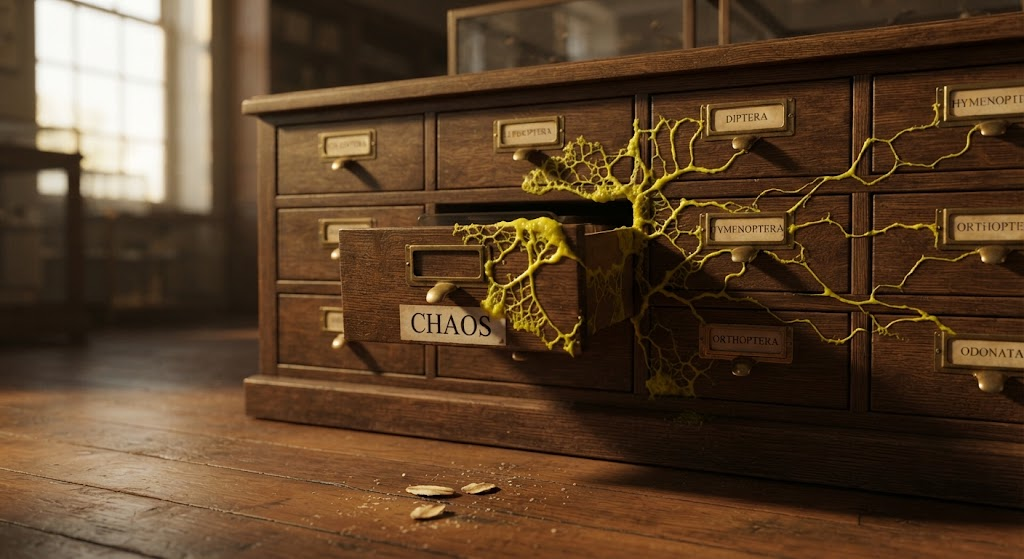
Linnaeus, who spent his life sorting living things into boxes, put the slime moulds in a genus he called Chaos. The name was a confession. Here was a thing that exuded slime but was not a mould, crept but was not an animal, made nothing from light and was not a plant, and could dry to a crust, wait a year, and wake up when it rained. The box was labelled with the absence of a box.
Samanth Subramanian’s long read for the Guardian picks the story up where taxonomy left it. Toshiyuki Nakagaki, forty years ago an undergraduate in Hokkaido, noticed a lemon-yellow stain in a petri dish moving at a centimetre an hour, and has spent his career since on Physarum polycephalum, a single cell with thousands of nuclei that can cover a couple of square metres of forest floor. In 2000 he had it find the shortest path through a maze to an oat flake. In 2010 he laid oat flakes in the pattern of Tokyo and its satellite towns, released the mould from the centre, and watched it build a network close to the actual railway map, and by some measures better. The mould does not solve the maze as a person would. It grows into every corridor at once and then withdraws from all but the shortest, which is a different thing, and the piece is honest enough to say so. Subramanian reared one himself while writing, on damp filter paper in a warm cupboard, and fed it oat flakes in the mornings between feeds for his five-month-old son, going from mould to child and back and trying to decide how he felt about the claim that the two of them sat on one spectrum.
The argument the piece is about is who gets to use the word, more than whether the mould is clever. For more than a century the working assumption was that cognition needs neurons, which put animals on one side of a line and everything else on the other, with humans at the far end of the animal side. Since the 1980s a group of biologists and philosophers, Pamela Lyon and Michael Levin the loudest among them, have argued that cognition is a property of life as such, and that the line was drawn where it was because the people drawing it stood there. The reaction has been what happens when a boundary is touched. Thirty-six plant scientists signed a letter in 2007 declaring that plant neurobiology added nothing to plant physiology and did not deserve the name. One signatory called it the last serious confrontation between the scientific community and the nuthouse. Levin gets hate mail. When Lyon co-edited a special issue on basal cognition for the Royal Society in 2021, one reviewer wrote that the idea was dangerous and must not be dignified in a journal of that stature.
The neuropurists, as Subramanian names them, have a real point. Alex Kacelnik, who has studied how New Caledonian crows use tools, says that an oak tree “decides” how many acorns to make and when to drop them, and that calling this cognition solves nothing. It trivialises the question of how the oak does it, or defines it out of existence. He will use the word only where he can show an internal algorithm and something like concept formation. That is a demand for precision, and precision is what words are for.
It is also, almost exactly, the demand McGilchrist’s left hemisphere makes of the world: sharp edges, fixed categories, the part standing in for the whole, and a discomfort with anything that will not sit still in its box. The category is a tool, and the trouble starts when the tool is mistaken for the “thing” it sorts. The oak goes on dropping acorns either way.
Levin’s reply is about what the line hides rather than what it protects. Neurons arrived late. For most of the history of life, cells found their way around without them, doing, in his phrase, pretty much the same thing at slower speeds, and evolution is a hoarder that does not throw away working machinery when a faster version turns up. He makes the point with the word “adult”. Nothing changes on an eighteenth birthday, but the law needs a line, so a line is drawn and everyone agrees to pretend. Cognition, memory and intelligence, he says, are that kind of word. Putting quotation marks around them when a slime mould is involved adds nothing scientific. It only says who is allowed to know.
Two things in the piece give the argument weight beyond semantics. David Glanzman at UCLA, working on the sea slug Aplysia, extracted RNA from slugs trained to stop flinching at electric shocks and injected it into untrained slugs, which then behaved as if they had been trained. The synapse, on this result, is where a memory is expressed, not where it lives. His own picture for it is a pianist who loses his hands and plays again with artificial ones. The paper, he says, cost him his National Institutes of Health funding and most of his lab. And Anne Pringle at Wisconsin asks the question that turns the debate around: why does Physarum have to be useful to humans, a designer of rail networks, a logic circuit, before it counts as interesting? Being a good engineer is a human value. The mould became important the moment it did something a human would be paid for.
Four days later in the same paper, Zoe Williams’s interview with Naomi Klein opens on a mountain at Davos in January, where Jared Kushner and Steve Witkoff described to an audience a gated paradise city to be built on Gaza, one of them with tears in his eyes. Klein’s new book with Astra Taylor, End Times Fascism, starts there because it is the scene in which the world’s richest men discussed the real estate potential of a mass grave without feeling the need to dress it up. Her account of the neoliberal decades is that the very rich used to stage what she calls seduction rituals, at Davos and Aspen and TED, promising to cure the sick and fund the schools so that nobody would fear their wealth. Those rituals have stopped. Peter Thiel’s panels before the 2024 election were titled “the enemy” and named sustainable development, the precautionary principle and social responsibility as the foes. Klein’s reading is that a small group now holds so much financial, technological and military weaponry that it no longer needs to be liked.
Wealth, she says at the end, has its own deranging effect. It almost inevitably turns the holder into a supremacist, because humans are creatures of story, and a person with that much in a time of that much want needs a story about why. The only story on offer is that there is something about them that justifies it. Once that story is in place, the rest of the living world is what the story is about being above. She calls them traitors to creation, and says she has earned the right to escalate. Asked where her anger comes from, she says the stars. She lives in a wild corner of British Columbia, and on a dark night the sky there was a blanket of them. Now satellites crawl through it, with a hundred times more promised. Who said Musk could, she asks. Who gave him that right. The orcas make her angry too. The advice she ends on is to find the place of deepest love and fight from there.
One gesture at two scales. Neither says so; the join is an interpretation. A discipline draws a hard line around intelligence and puts humans above it. A class draws a hard line around desert and puts itself above it. In both cases the line is defended as precision and functions as rank. Lyon says it in the last paragraph of the slime mould piece: if all living things have a share of what humans value in themselves, then attention would have to be paid to what is being done to the rest of the living world. Klein says it from the other side of the line, about people who have decided the rest of the living world is not their problem. Slime moulds are the case where the line is being contested from below. Billionaires are the case where it is being redrawn from above, and the redrawing is going faster.
The slime mould piece has a sentence that belongs in both stories. Silicon Valley, one scientist remarks, loves the biogenic camp, because any account of intelligence as data and computation validates the I in AI, and there is no better way to treat humans as machines than to start treating machines as humans. That is the same line again, drawn in silicon, and the people paying for it are the ones on the mountain.
The mechanism Klein describes, an advantage handed out and a story of merit grown over it, has been produced in laboratories with people who watched the advantage being handed out.
Molina, Bucca and Macy had 996 people play a card game online in which, between rounds, the winners of the last round kept their strongest cards and the losers handed theirs over, or the reverse, or cards were swapped at random. Winners were twice as likely as losers to call the outcome fair whichever way the rules tilted, and more likely to put it down to talent, in a game where talent played no part.
Deffains, Espinosa and Thöni gave people a counting task in a hard or an easy version, assigned by lot and never disclosed, then told them whether they had scored above or below the median. Those above it credited their effort and, asked to move money between two other people whose earnings were not theirs, moved less of it. Those below blamed the task and moved more.
Kandul and Nikolaychuk handed out the dictator’s role in a dictator game by a guessing procedure that was random in effect, and the people it favoured rated the procedure as more deserving and kept more of the money. Power does something of the same kind to the view of other people.
Gruenfeld, Inesi, Magee and Galinsky found in 2008, across six studies, that people put in a position of power approached others according to their usefulness to the goal in hand, regardless of their other human qualities, and that the effect held across several ways of granting power, several kinds of goal and several kinds of usefulness.
That is Klein’s story about why, and the first step towards her people as things, produced in an afternoon by an advantage the winner had seen dealt. What the laboratory cannot supply is the return: less redistribution leaving the advantage to grow. That edge is Piketty’s, from the national accounts rather than a game: where the return on capital outruns the growth of the economy, wealth concentrates unless it is taxed back, and the concentration of the nineteenth century was undone in the twentieth by wars and progressive taxation rather than by any change of heart. With that edge in place the three close.
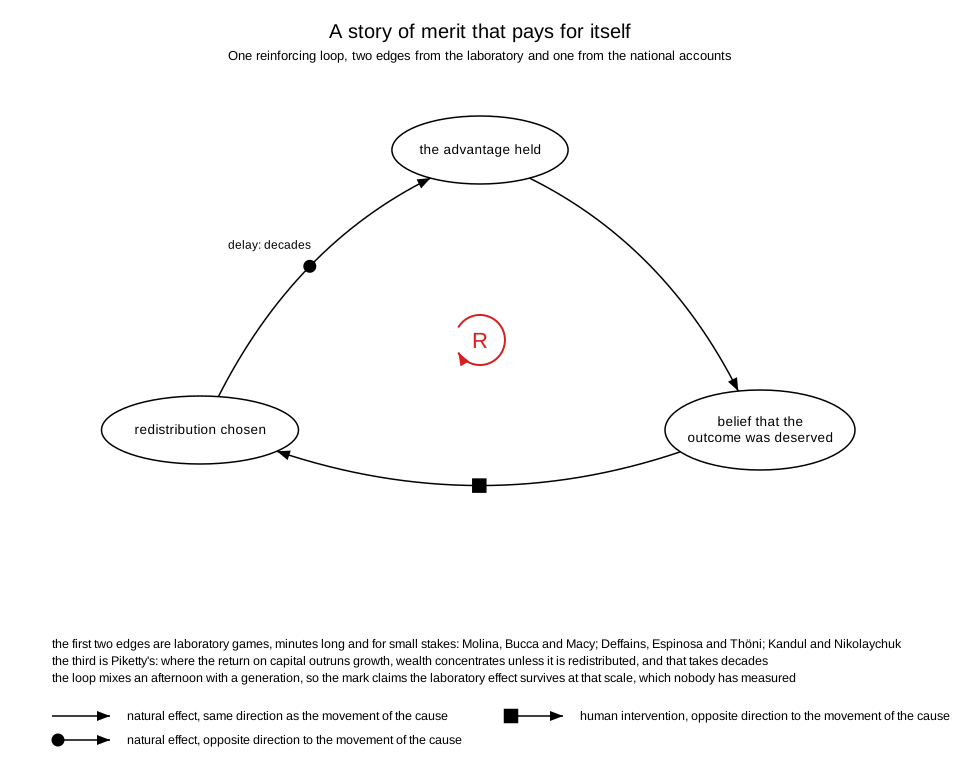
Two edges run opposite to their cause, so the count is even and the loop reinforces, and the one decision in it is the redistribution chosen, which is where Klein’s story does its work. The mark carries a caveat the drawing states in its notes: the first two edges were measured in minutes, for small stakes, and the third runs over decades. Whether an afternoon’s self-flattery scales to a generation’s tax policy is the claim the loop makes, and nobody has measured it. Klein’s spiral is this loop with time added, going round and not coming back to the same place.
What has not held up is the claim about the wealthy themselves. Piff and colleagues reported in 2012 that people of higher social class behaved less ethically across seven studies, including two on the street: drivers of more expensive cars cut off other drivers at a four-way stop, and pedestrians at a crossing, more often than drivers of cheap ones. The finding travelled a long way. Jung, Smeets, Stoop and Vosgerau reran both field studies in 2023, preregistered and with larger samples, and found no relationship between the car and the behaviour. A pair of Austrian replications the same year found none either, and direct replications of two of the laboratory studies came back empty as well. So the deranging effect has been shown in people handed a rigged win, and not shown in people who happen to own an expensive car. As a claim about the handful of people who own a satellite constellation, nobody has measured it, because there is no control group and they do not fill in questionnaires. Klein’s evidence is what they say in public, which is a different kind of evidence, and her point is that they have stopped bothering to disguise it.
The slime mould, meanwhile, is doing what it did before the argument started. In 2008 Nakagaki blew cold dry air over a Physarum once an hour, three times, and it slowed each time. On the fourth hour, with no air, it slowed anyway. Nobody knows how it keeps time. Linnaeus had it right the first time. Chaos was the box for everything that would not go in a box. It is the only one in the whole system that has never needed correcting, since nothing put in it has yet agreed to be anything else. The slime mould has not been consulted.