
Two brain hemispheres, structurally asymmetrical, doing different things and attending to the world differently. The pop-science version, in which logical people are left-brained and artistic people are right-brained, is not the story McGilchrist tells. His claim is stranger and more ambitious: the difference runs far beyond that caricature, because the left is exceptionally good at narrowing, categorising and manipulating what it has grasped, while the right keeps the wider situation in view. One of them is a wonderful servant. The trouble starts when the servant starts running the household.
In his account the right hemisphere, wild, flowing and metaphor-loving, has a use for the left and knows it. The left behaves as if it has no use for the right at all. Denial, thy name is cortex.
The argument comes from The Master and His Emissary (Yale University Press, 2009). Its first half is neuroscience: the two hemispheres attend to the world in two different ways, the right broad, vigilant and open to whatever is new, the left narrow, grasping and already sure. Its second half is history, told as the slow victory of the left’s way of attending. The closing pages ask what a society would look like if that victory were complete, and answer with a list: abstraction, virtualisation, bureaucracy, mechanism, exploitation, control, and a culture that has stopped taking part. Most items on the list can be reconstructed as loops. Loops, edges and a source per arrow are the left’s tools, and the left is holding the pen. The other one keeps the woodland in view.
Systems thinking, now with added blind spots
The left hemisphere hates ambiguity. The big picture lacks the neat edges it loves, so it swaps the picture for a restricted, highly detailed and completely myopic view, and the parts become more real than the whole.
Specialisation explodes. Technicised knowledge, which is to say jargon and academic turf wars, replaces the understanding that comes from having done the thing. If it is not on paper or in a spreadsheet, did it even happen? The details get refined while the forest goes missing, along with the raccoon in the undergrowth. Whatever cannot be measured becomes irrelevant, and people who focus on seeing more of the whole are dismissed as dreamers, or worse, as unqualified.
When in doubt, skill is replaced with tokens and procedure. Certificates are shiny. Experience is not. The practitioners who learned on the job are phased out in favour of experts who have mastered the handbook and never faced the thing the handbook is about, and what remains of skill is standardised, algorithmic, regulable, applied evenly, like bland icing on a very confused cake.
In McGilchrist’s telling the chain runs from a focus on abstraction to a preference for the measurable, from there to the marginalisation of holistic and experiential understanding, from there to reliance on formal systems and paper certification, and from there to models that stand ever further from the thing they model. Then the abstracted view is the only one on the table, and the chain closes on itself.
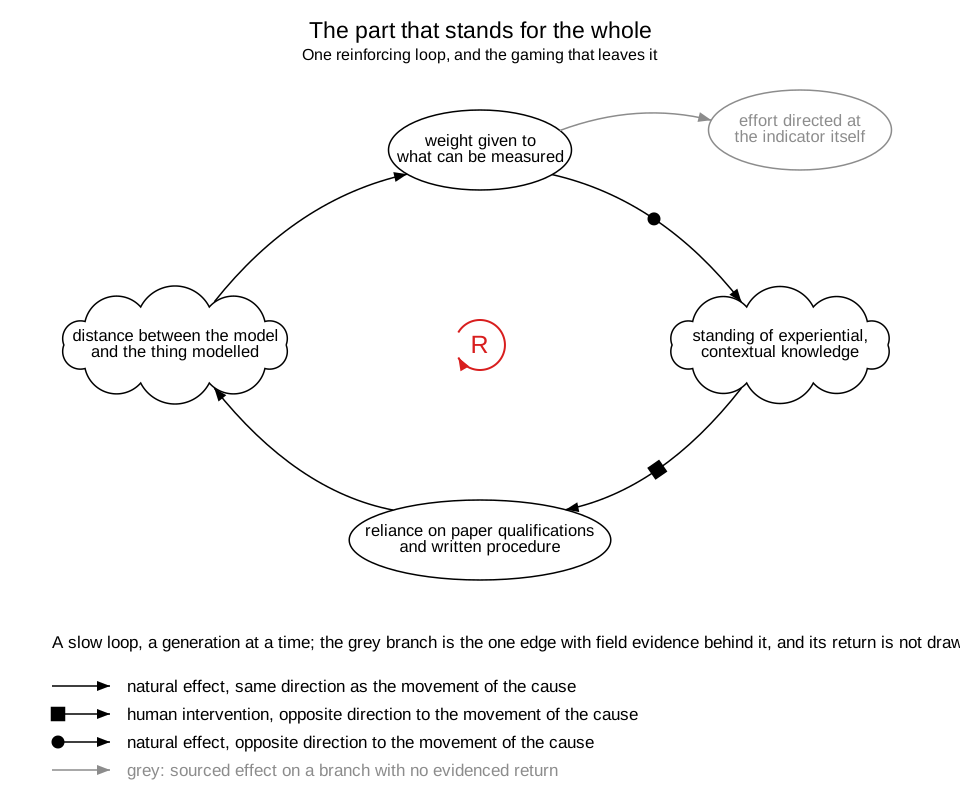
The signs make this a reinforcing loop: if the relationships hold, each turn can give the measurable a little more weight. The single decision in it is the organisational choice to require formal evidence, a certificate or a written procedure, in place of demonstrated competence, and that is where anyone wanting to slow it would have to stand. The grey branch is the one edge with field evidence behind it. Campbell’s law, from 1976, says that the more a quantitative indicator is used for decisions, the more it will be gamed and the more it will distort what it monitors, and Bevan and Hood found exactly that in the English NHS of the early 2000s. What a gamed indicator does next to the weight given to measurement is not drawn. The one source records the opposite of a correction: after the gaming was found, England moved the auditing of data quality to a body with no presence in the hospitals and leaned further on readily available data, which Bevan and Hood describe as widening the audit hole rather than narrowing it. One observation is not an edge.
Who needs reality when there is a keyboard
In McGilchrist’s picture the concrete gets swapped, slowly and surely, for the abstract. Bodies, touch, nature, art, all reduced to ideas. Nobody needs to interact with anything in the real world when there is a keyboard. The book’s word for it is virtualisation.
In its extreme form, work becomes the act of documenting and justifying work. Doing the thing itself is for the marginalised. The job is to make a slide deck explaining how someone else is to do the thing the presenter will never touch, and the physical work that remains is pushed out of sight, under the abstraction layers, to precarious people.
The book’s chain runs in one direction. The concrete is replaced by the abstract; humans and the world get conceptualised, bodies treated as systems and identity as metadata; experience arrives through meta-representations; fewer people work with material reality; work turns into meta-work, with systems built for monitoring outrunning systems built for care. Policy drifts loose from consequence, optimisation replaces understanding, and the whole thing feeds the bias that started it: concept over contact, clean data over messy life.
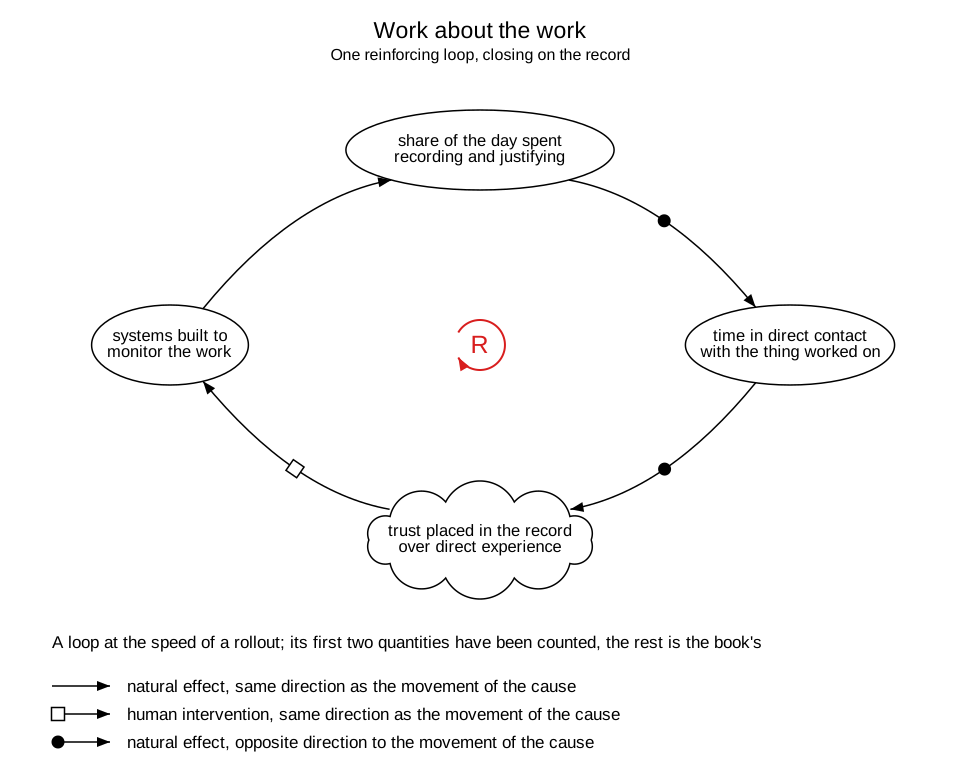
The loop closes on the record. More of the day goes to the record, less to the thing, the record becomes the more trusted of the two, systems are built to read it, and the systems demand more recording. The one decision in it is the building of a monitoring system. The first two quantities have been counted, for physicians and for teachers. The evidence does not establish the next step, from reduced contact to greater trust in the record, because that edge belongs to McGilchrist’s argument. What the after-hours work feeds has not been established, so no edge leaves for it. Sinsky’s physicians will have known the loop without a drawing, the way anyone knows the shape of their own day.
Nothing says progress like more paperwork
Expect a bureaucracy boom. Abstract systems of control, procedure-obsessed, predictable, anonymised, equal-ish, and above all abstracted. Everything becomes interchangeable and depersonalised. Uniqueness goes; take a number and wait for the metaphysical redundancy.
McGilchrist’s own image for the left hemisphere is a high-ranking bureaucrat, protected from the world it administers, adept at knowing and observing the rules and knowing little of life as it is lived. Bureaucracy is not a by-product of that world. It is the ideal.
Life as a broken toaster
In the book’s picture, life gets modelled on the mechanical. Speed, precision and capacity become the only metrics, never mind that turning those dials in the real world usually wrecks things. Quality is replaced by quantity, humans become numbers, context vanishes, and degrees of variation are crushed into binary decisions: yes or no, on or off, tick the box or begone.
The world gets redesigned to suit left-hemisphere values: measurable, repeatable, soulless. Quantify everything, reduce each relationship to analysable components, abandon context. Individual integrity is surplus to requirements. Mystery and wonder do not fit the database schema. Values turn utilitarian, morality reduces to a cost-benefit analysis, and what is left is enlightened self-interest, with the enlightenment negotiable.
This is the one part of the list that does not close. In the book it is a chain. Reification, the living treated as things, feeds a mechanistic model of life. That model shifts consciousness towards a bureaucratic mindset and shapes mass production around measurability and componentiality. Individuality erodes as the person becomes a function. Exploitation follows, the impersonal replacing the personal and humans and nature counted as resources. Social cohesion frays, governments turn commodifier and plunderer, and at the end sits a systemic paranoia in which everyone distrusts everyone and institutions feign virtue. Nothing in the book sends the last step back to the first, so it stays a chain, and a chain gets no loop mark.
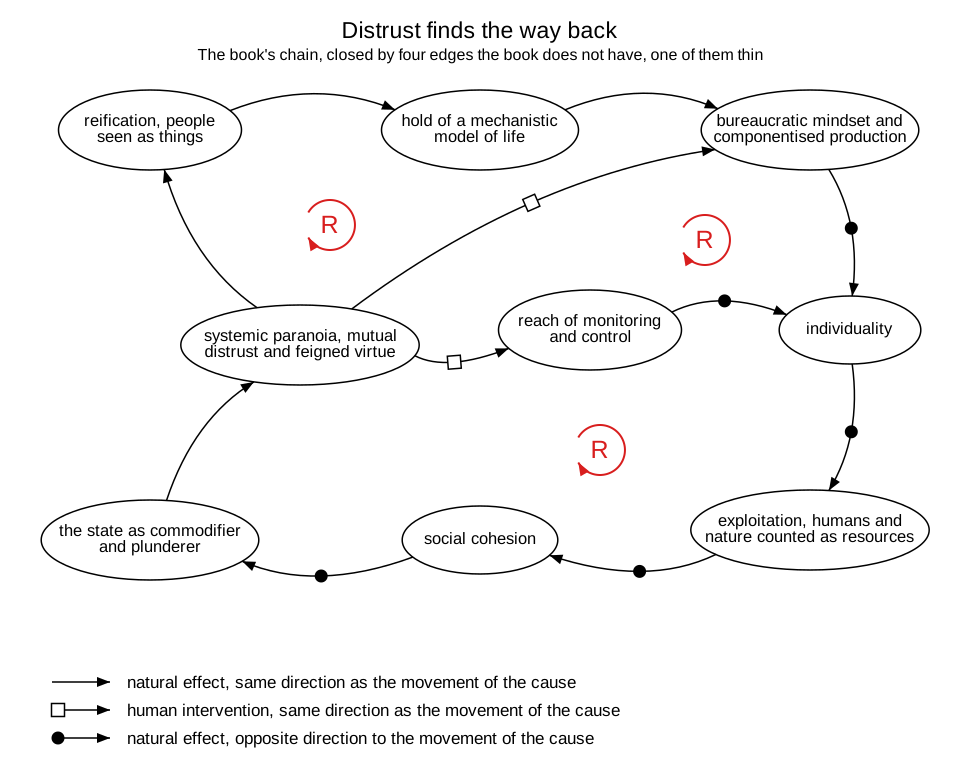
Closing it took help from outside the book. The four edges that leave paranoia are not McGilchrist’s, and the drawing would be cheating if it let them pass as his. Theodore Porter’s Trust in Numbers has quantification arriving wherever trust in a person’s judgement has run out, which carries distrust back into the bureaucratic mindset. O’Neill’s Reith lecture has distrust answered with monitoring. Penney, and Marthews and Tucker, watched people read and search less once they knew they were watched, which takes monitoring into individuality. Those three close two loops through paranoia, one by numbers and one by monitoring, and both count even, so both reinforce.
The fourth edge is the thin one, and the ring it closes, four opposites and an even count, is marked on that understanding. The experiment that would settle it, making a group of people distrustful and watching whether they come to see others as things, has not been run. What there is comes from the study of prejudice. Harris and Fiske found that groups judged both hostile and incompetent, the homeless and drug addicts in their photographs, were processed by their participants’ brains the way objects are, without the activity that other people’s faces produce, and in their model the judgement of hostility is the friend-or-foe call that distrust is made of. Kteily and colleagues found people rating a group nearer the ape end of a scale in the days after an attack. So the quantity at the top of the ring has been narrowed to people seen as things, which is what was measured, and the connection to distrust is read off how warmth is defined rather than tested. Waytz and Epley lean the other way: people who felt securely connected to their own circle dehumanised outsiders more, not less, so frayed cohesion is not obviously what does it.
All for one and none for you
As the impersonal replaces the personal, things come to be valued over living beings. Connection and trust are hard to measure, so they go unvalued. Social cohesion is neglected or actively dismantled, relationships are depersonalised, and exploitation becomes the default mode of interaction, between humans and between humanity and the rest of the planet. Cue resentment.
That resentment is perfect soil for an authoritarian equality, a flattened sameness that is anything but just. Balance gives way to a one-size-fits-all ideology, ripe for export, by force if necessary. Marginalised groups get extra marginalised. Paranoia blooms. Trust dries up. People, groups and governments all suspect each other, and the benevolent overlords come to see themselves not as servants of the people but as their evolutionary betters.
Smile, you’re on Bureaucracy-Cam™
Liberty is praised in the abstract while individual freedom is quietly throttled. Surveillance becomes normal. A DNA database arrives, introduced against some exceptional threat, and its real aim is control rather than safety. The state gathers power while pushing responsibility out of the window, and the people follow suit, losing their sense of agency along the way. Altruism is treated with suspicion. Family roles and the skilled professions that run on trust, priests, teachers and doctors in the book’s list, threaten efficiency, so they are brought under bureaucratic control, just in case.
The book’s own summary line for this part is already a loop: more control, more disenchantment, more passivity, more control. Drawn as quantities, it closes through trust.
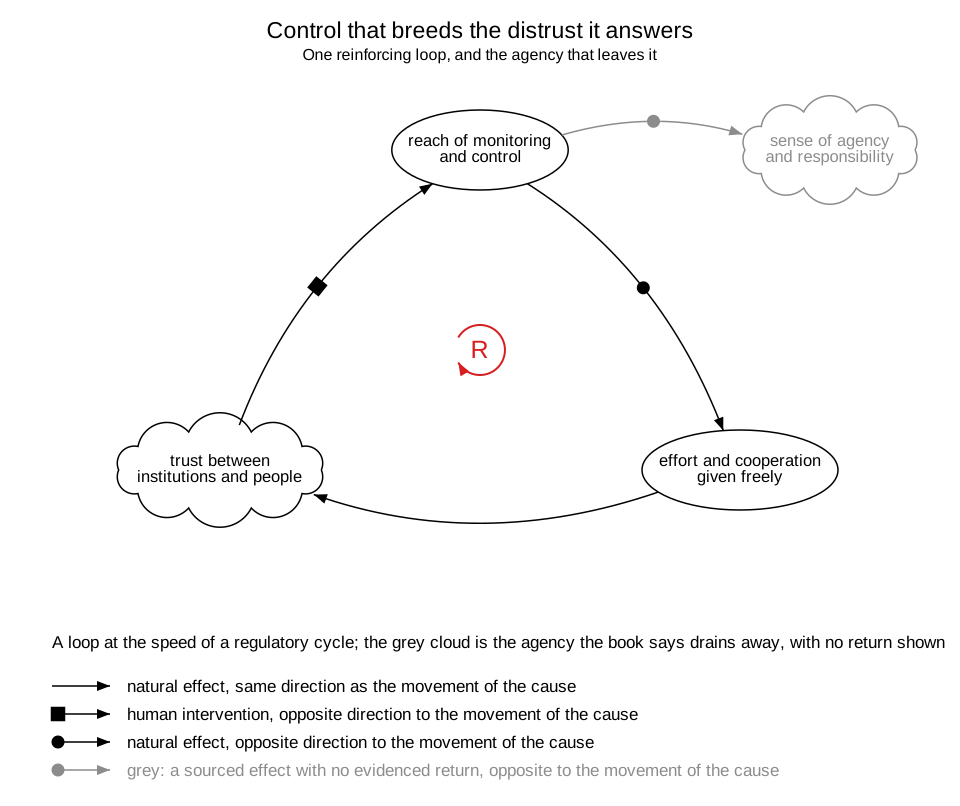
Control signals distrust and the controlled give less. Less given freely means less trust. Less trust is answered with more control. The signs make this loop reinforcing too, if the relationships hold, and the decision in it is the answer to distrust. The first edge has an experiment behind it and the third a Reith lecture; the second is the book’s. The grey cloud is the loss of agency the book predicts, which nobody has shown joining back up.
Manifestations
The book’s other items are manifestations rather than mechanisms. The book states them without drawing a loop through them, and most of them have no measurement to set against them.
A well-oiled machine with no soul
Death becomes taboo, illness becomes the patient’s fault, and organs become replaceable parts in the new biotech economy. Sex, stripped of subtext, is splashed everywhere like cheap perfume. Reasonableness is replaced by rationality, and common sense, which needs both hemispheres, fails outright. Insight, responsibility and empathy are too right-hemisphere and too messy; what arrives instead is aggression, rigidity, denial, and the inability to change one’s bloody mind.
Because you’re worth it™ (not really)
Autonomy is a quaint idea from the past. Everyone is passive now, suggestible, manipulable, and people come to see themselves as exposed to culture the way a photographic plate is exposed to light. Nobody chooses to use a thing; they are exposed to it. Willpower is dead, unless the drive to acquire more stuff and manipulate others counts. So use the thing, click the thing, post on the thing. Consume, conform, be watched, be analysed, be monetised. Welcome to the Panopticon Mall.
Killing the magic
Awe and wonder are reclassified as delusions, and spirituality as fantasy for the weak. The left hemisphere hates being led by what it cannot control, so it ridicules it: the right’s love of pathos is shamed and its yearning for meaning mocked. Flow, time, shape and decay go with it. Everything fragments into moments, each copy-pasted from the last until boredom sets in. And it will set in.
Culture as a playlist
Participation stops and spectating starts. Art goes conceptual and loses depth. Music devolves into rhythm with the soul of a metronome. Dance turns inward. Words proliferate, abstract and hollow. History is irrelevant, tradition a liability, the body a machine and nature a resource depot. Anything wild, anything not efficiently managed, is dangerous and gets domesticated. Now.
What has been measured since
The book’s complaint is with letting a reading by loops and sources be the only one. Reviewers split the book in two. The neuroscience half has fared better on the narrower claims about lateralised attention and complementary processing. The cultural half is where the argument becomes much harder to defend. Alan Carson, reviewing it for the British Journal of Psychiatry in 2010, found the conclusions going far beyond the data, and even sympathetic coverage, such as Nick Spencer’s in Prospect, spends its opening separating the thesis from the pop caricature of logical left-brainers and dreamy right-brainers, which McGilchrist rejects as firmly as his critics do.
The cleanest demonstration of the two ways of attending is in chicks. Rogers, Zucca and Vallortigara set strongly and weakly lateralised chicks to pecking grain from among pebbles while a model predator passed overhead. The strongly lateralised chicks fed with the left hemisphere and watched for the predator with the right, and did both at once. The weakly lateralised chicks were slow to spot the predator and, once they had, could no longer tell grain from pebble. The loops are the pecking, and the eye on the sky is everything else. In humans, damage to the right hemisphere’s attention networks produces neglect, in which the left half of the world goes unnoticed though the eyes still see it, a syndrome Corbetta and Shulman reviewed in 2011 and one that is milder and short-lived after damage on the left. There is a related phenomenon in the split-brain literature: Gazzaniga’s interpreter, the system that produces a confident reason for behaviour even when the mechanism that produced it is inaccessible.
The measurement loop has the best-documented open branch. Campbell’s law was set down in 1976: the more any quantitative social indicator is used for social decision-making, the more subject it will be to corruption pressures and the more apt it will be to distort and corrupt the processes it is intended to monitor. Gwyn Bevan and Christopher Hood tested it on the English NHS star ratings, published from 2001, and found gaming by hospitals and ambulance services alongside the reported improvements, which the devolved health services, with targets but without the sanctions, did not match. The loop itself rests on the crowding out of experiential judgement by paper, which O’Neill and the book both argue and nobody has measured.
The meta-work loop has its first two quantities counted. Sinsky and colleagues followed 57 physicians for 430 hours in the summer of 2015 and found 27 per cent of the office day in direct contact with patients and 49 per cent on the electronic record and desk work, with another one to two hours of the record each night at home. The Department for Education’s 2019 workload survey had teachers in England at 49.5 hours in the reference week, 21.3 of them teaching, with most reporting too much time on data management and general administration. Neither study tests what the extra hours feed, which is why the loop closes on the record and nothing leaves it.
The bureaucracy boom is where the evidence turns against the book, at least as felt from inside. David Graeber’s 2013 essay on bullshit jobs put the share of workers who consider their own job pointless somewhere between a fifth and a half. Soffia, Wood and Burchell checked that against the European Working Conditions Survey and found 7.8 per cent of EU employees saying their work was not useful in 2005, falling to 4.8 per cent in 2015. Whatever has happened to bureaucracy, the people inside it do not, on the whole, report the emptiness the book predicts for them.
The control loop has an experiment on its first edge. Falk and Kosfeld let principals choose whether to impose a minimum on their agents’ effort, and most agents answered the imposition by giving less than they would have given untouched, so that principals who trusted earned more on average than principals who controlled. Frey had argued the mechanism in 1993: where the relationship between principal and agent is personal, monitoring is taken as distrust and effort is withdrawn in reply. The third edge, distrust answered with control, is Onora O’Neill’s account of the audit explosion in her 2002 Reith lecture: everyone agreed that the remedy for a crisis of trust was more accountability, and what arrived was ever more perfect administrative control, with performance indicators displacing professional judgement in hospitals, schools and universities. The DNA database is not a prediction that came true, since the book was written after the fact. When McGilchrist wrote, England and Wales were retaining the DNA of anyone arrested for a recordable offence, of any age, indefinitely, convicted or not, and in December 2008 the European Court of Human Rights found that retention blanket and indiscriminate and a disproportionate interference with private life. Trust, one of the quantities the loop would consume, is low where it is measured: in the OECD’s 2023 survey of 30 countries, 44 per cent of people reported low or no trust in their national government against 39 per cent with high or moderately high trust. That is a level, not a trend, and it says nothing about which way the loop is turning.
The four returns on the mechanism chain come from outside the book. Porter’s Trust in Numbers makes the case that quantitative rigour arrives under political and social pressure, as an alternative to trusting a person’s judgement, which is distrust answered with numbers. Penney found traffic to Wikipedia articles on privacy-sensitive topics falling after the surveillance revelations of June 2013, at once and in the longer trend, and Marthews and Tucker found the same in Google search terms that users rated as likely to get them into trouble, across the countries they studied. Kteily and colleagues validated a blatant measure of dehumanisation, a slider along the Ascent of Man picture, across seven studies in three countries, and found it spiking after the Boston Marathon bombings and the Woolwich attack and predicting support for torture and retaliation. Harris and Fiske showed ten participants photographs of social groups and found medial prefrontal activation, the signature of thinking about a person, for every group except those stereotyped as hostile and incompetent, who produced the disgust pattern that objects do. Waytz and Epley led participants to feel socially connected and found them attributing fewer mental states to distant others and recommending harsher treatment for them, across four experiments.
Three of the culture predictions have a measurement of some kind. Serrà and colleagues took the pitch, timbre and loudness of recordings from 1955 to 2010 and found pitch transitions narrowing, the timbral palette homogenising and loudness rising throughout. Rhythm was not in the dataset, so “little more than rhythm” is untested; what was tested points the way the book says. Konrath, O’Brien and Hsing pooled 72 samples of American college students who had filled in the same empathy questionnaire between 1979 and 2009, 13,737 students in all, and found empathic concern down 48 per cent and perspective taking down 34 per cent, most of the fall after 2000. That is one questionnaire and one country’s students. For spectators and participants there is a single year’s snapshot and no series. The Taking Part survey for England has arts engagement at just over three quarters of adults from 2005/06 to 2017/18. In the last of those years more attended than took part, 69 per cent at an arts event against 53 per cent doing an arts activity, and the report says nothing about whether the second is falling relative to the first. Death as taboo and sex as omnipresent remain unmeasured, and may not be measurable in the form the claim takes, which is a limit of the method rather than of the claims.
All aboard the Left-Hemisphere Express
The cultural half of the book is too large for a verdict on whether McGilchrist was right about bureaucracy, abstraction or control. The relationships he proposed are a smaller target: either they form self-reinforcing systems or they do not, and either the evidence reaches an edge or it does not.
Three reinforcing loops can be drawn from the book’s argument, and a fourth part of it, the mechanism chain, closes only with edges borrowed from other people’s work. Each of the book’s three is structurally reinforcing, each carries exactly one decision, each has evidence touching one edge, and none has been demonstrated as a complete loop. Some of the remaining edges are plausible. Some are merely asserted. One prediction outside the loops, the felt emptiness of bureaucratic work, has evidence against it.
McGilchrist closes the thought experiment with a plain sentence: this is what the world would look like if the emissary betrayed the Master. He wrote it in 2009 with the DNA database already in place, the star ratings already gamed and the audit explosion already old enough to have a name, so prophecy is the wrong word for it. Some of the machinery was there when he wrote. Whether the machinery reinforces itself, nobody has yet shown. The rest of the great flattening, lovingly assembled by the hemisphere that has forgotten how to love, is still waiting for someone to measure it. Something in the undergrowth just moved.