At the end of September Brian Holmes asked nettime what anyone expects to get out of AI. Years ago he and Armin Medosch read Carlota Perez on technology surges, and the next surge they expected never came. Felix Stalder answered with Ilias Alami’s essay on imperial state capitalism, a set of data-centre numbers, and a guess: when the AI bubble bursts, the machinery may be turned towards geo-engineering. Holmes agreed, and added a permanent emergency, AI-driven micro-surveillance justified by what the technology lets a single person do, and Polanyi’s freedom in a complex society as the problem ahead.
Both replies have owners in them: Alami’s state shareholders in Stalder’s, a contest for hegemony in Holmes’s. Both still place the deciding moment after the bubble bursts and the emergency arrives. Much of what comes next may already be decided, by whoever holds the stakes and keeps the lists. The future is already here, not unevenly distributed so much as unevenly owned. Winter is coming, for AI also. The gains from a technological transition often follow whoever owns what survives it. The firewood is already being signed for.
In on the ground floor
States and their sovereign funds have been buying into the same machinery, from Paris and Seoul to the Gulf, Beijing and Washington. France’s state shareholding agency holds stakes in some 86 companies, and a dedicated vehicle, Lac1, takes long-term positions in listed French multinationals to stabilise their shareholding. In May 2025 the French public investment bank Bpifrance, Abu Dhabi’s sovereign vehicle MGX, Mistral and NVIDIA announced a joint venture for a 1.4 GW AI campus in the Paris region. South Korea’s state fund has put 250 billion won into the chip designer Rebellions and 100 billion into the language-model start-up Upstage. In the Gulf, MGX holds OpenAI, Anthropic and SpaceX, which now contains xAI. Saudi Arabia’s PIF has committed around 100 billion dollars to a state-owned AI champion. Chinese government venture funds channelled an estimated 912 billion dollars into strategic industries over the past decade, about 23 per cent of it into AI-related firms. The US federal government made around thirty equity deals in a single year. Nobody keeps a consolidated ledger. Alami counts sovereign funds behind roughly two out of three of the largest unicorns, and describes the EU, caught between rival stacks, using state capital to sponsor domestic AI champions, digital infrastructure and so-called sovereign military technology.
The holdings are not scattered. They sit in one stack: AI labs, the data centres and chips under them, the minerals in the chips, the energy that runs them, and the weapons increasingly built on top. What UNCTAD calls strategic sectors drew 44 per cent of announced greenfield investment in 2025, up from 16 per cent in 2020.
A minority stake is a modest instrument. Modesty is most of its charm. It is faster than founding a state laboratory, draws private money in rather than pushing it out, sells more easily as “a stake for taxpayers” than as nationalisation, and works inside the investment treaties and arbitration tribunals that, as Alami puts it, were built to make outright expropriation costly after the wave of Third World nationalisations. Nothing has to be seized. It is bought, quietly, while the story is still about progress. The claims on the future are being recorded now, at present prices.
Closing-down sale
Technology booms have ended in crashes before. The crash is often when ownership of the surviving assets becomes visible. In Carlota Perez’s account, the aftermath of a major technology bubble is a season of mergers and acquisitions in which the surviving giants mop up the weaker firms and whatever useful assets they held, ending in oligopolies across the economy. What follows depends, in her reading, on the capacity of the state to restrain finance and hand investment back to production.
The telecoms bust after 2000 shows the pattern at close range. By 2002 the sector had seen more than sixty bankruptcies, and no more than two per cent of North America’s long-distance capacity was in use. The fibre stayed in the ground. Firms with strong balance sheets bought assets at very low prices against what had been paid for them. Level 3 bought Genuity out of bankruptcy and went on to absorb WilTel, Broadwing and others; by 2007 half or more of the traffic on its backbone was video. Global Crossing filed for bankruptcy in January 2002, listing 22.4 billion dollars in assets, and in 2011 Level 3 took it over in an all-share deal. The companies died. The fibre changed hands. The physical capacity for the following decade’s traffic was already in the ground in 2002, unlit. When demand arrived, it found the glass under new management.
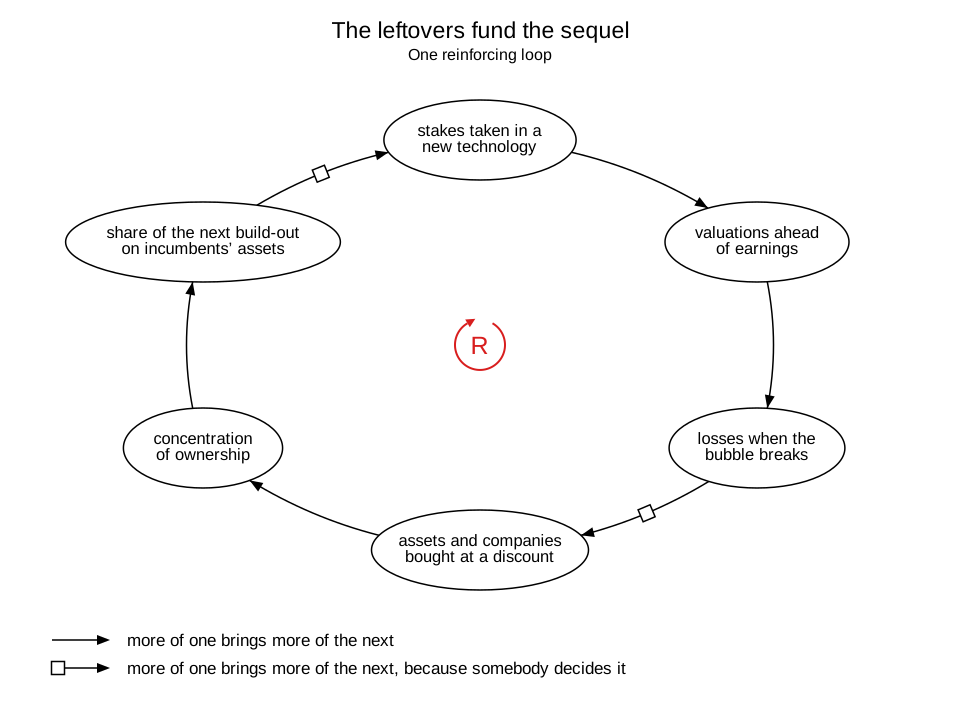
AI infrastructure is next in line for the same sale. A failed model company leaves behind buildings, chips, power contracts, network connections and code. Some of it will keep its value and some will not: chips age fast, and a power contract can turn into a liability. A crash may do two things at once: test which parts of the installed base still have a use, and transfer the claims on those that do.
Perez’s sequence assumes a state standing outside the casino. A state holding equity is sitting at the table. It has chips. A public stake does not by itself decide what happens: the state can sell it, keep it, distribute its returns, attach conditions to it, or use it to preserve a capability rather than to fetch the best price. It changes who is in the room when the settlement is made.
When the bust comes, part of the loss lands on public balance sheets, and the assets become available to whoever can carry the loss, refinance the debt or buy the distressed claim: the largest firms, the deepest-pocketed investors, and states or sovereign funds with the reserves to do so. In Alami’s survey the firms and the states are increasingly hard to tell apart. Gulf monarchies build AI champions with dual civilian and military mandates, run by the same security elites who control the sovereign funds. Russia’s war economy fuses oil revenue, defence conglomerates and a facial-recognition champion. European states sponsor sovereign military technology and domestic champions. In the United States, tech executives hold reserve commissions and the Pentagon holds stakes in the companies supplying it with autonomous weapons.
A crash under those conditions is not a reset. It is a closing price. The discount usually goes to whoever can afford to wait.
Terms and conditions apply
Ownership decides who can provide. Lists decide who can receive. In August the United States designated Autistici/Inventati, an Italian collective running mail, blogs and mailing lists, without charge or hearing. The list was American; the hands that carried it out were mostly European. An Italian cooperative bank, Banca Etica, closed the account and called itself forced. The collective took it to court in Pisa, where its lawyer argues there was no legal obligation. The state does not need to own the bank. It needs the bank to believe that keeping the relationship costs more than ending it. Each intermediary decided for itself, and none of them needed an order. Within a fortnight the collective had shut down. The defence that had held through every earlier seizure was having nothing to hand over. The State Department described the result as users “anonymous, untraceable, and beyond the reach of the law”.
Europe keeps lists of its own, and has been sharpening them: since 2024 a directive obliges member states to make deliberately violating Union restrictive measures a criminal offence, and companies in the Union are obliged to use their best efforts to stop entities they own or control abroad from undermining the Union’s Russia sanctions. The list decides who may be served. The ledger decides who owns the servers. Alami notes governments using the same tools for domestic surveillance, predictive policing and social media tracking under the heading of security, with no plague or catastrophe required to begin. Surveillance does not wait for the emergency. The paperwork will do.
Off the grid
Some ownership is too dispersed to collect. In the twelve months to June 2025, solar panel imports into Africa rose 60 per cent, and outside South Africa they nearly tripled in two years. Ember’s reading points to rooftops rather than solar parks: shops, offices, churches and small factories, driven by power cuts and the price of diesel. Against diesel at Nigerian prices, a panel can pay for itself in about six months, before counting inverters and installation. In Sierra Leone the panels imported in a single year could, if all instslled, generate the equivalent of 61 per cent of reported national generation, a figure Ember itself warns may be inflated.
A continent’s worth of rooftops cannot be designated as a group, bought at a discount in a crash, or entered as a line on a sovereign balance sheet. It is hard to put a church roof on a sanctions list. Ownership at the point of use does not dissolve the concentration upstream, though. China made about 80 per cent of the world’s solar panels in 2024, and the inverter, the finance and the grid connection can sit in still other hands. There are two ledgers: who owns the means of making the equipment, and who owns the productive asset once it is on the roof. The open question is whether the second changes the bargaining power created by the first.
Polanyi ended The Great Transformation on a test rather than a hope: regulation extends some freedoms and restricts others, and only the balance counts. In the same chapter he asked for the right to nonconformity to be protected by institutions, so that the objector keeps a niche and a life to live. Dispersed ownership can create room for action; whether that room stays open depends on institutions. A mail server that declined to remember opened such room too, until a list closed it.
Delivery to follow
What will settle the next decade is already on record: equity stakes with dates and percentages, infrastructure under construction, designations on sanctions lists, import statistics by country and month. The crash may sort which parts of the installed base have a future. Who owns those parts, who may reach them and who can afford to carry them through the fall is being decided now, at present prices. The future is usually sold before it is delivered.