Peace has running costs

Organised violence tends to appear where the substrate makes it the higher-return move, and to recede where it does not. That is one way to read the origins of war. Inverted, the same reading yields a second claim, less obvious and more useful. If war is what the ground rewards under some conditions, then peace is what…

July 16, 2026 · 9 min
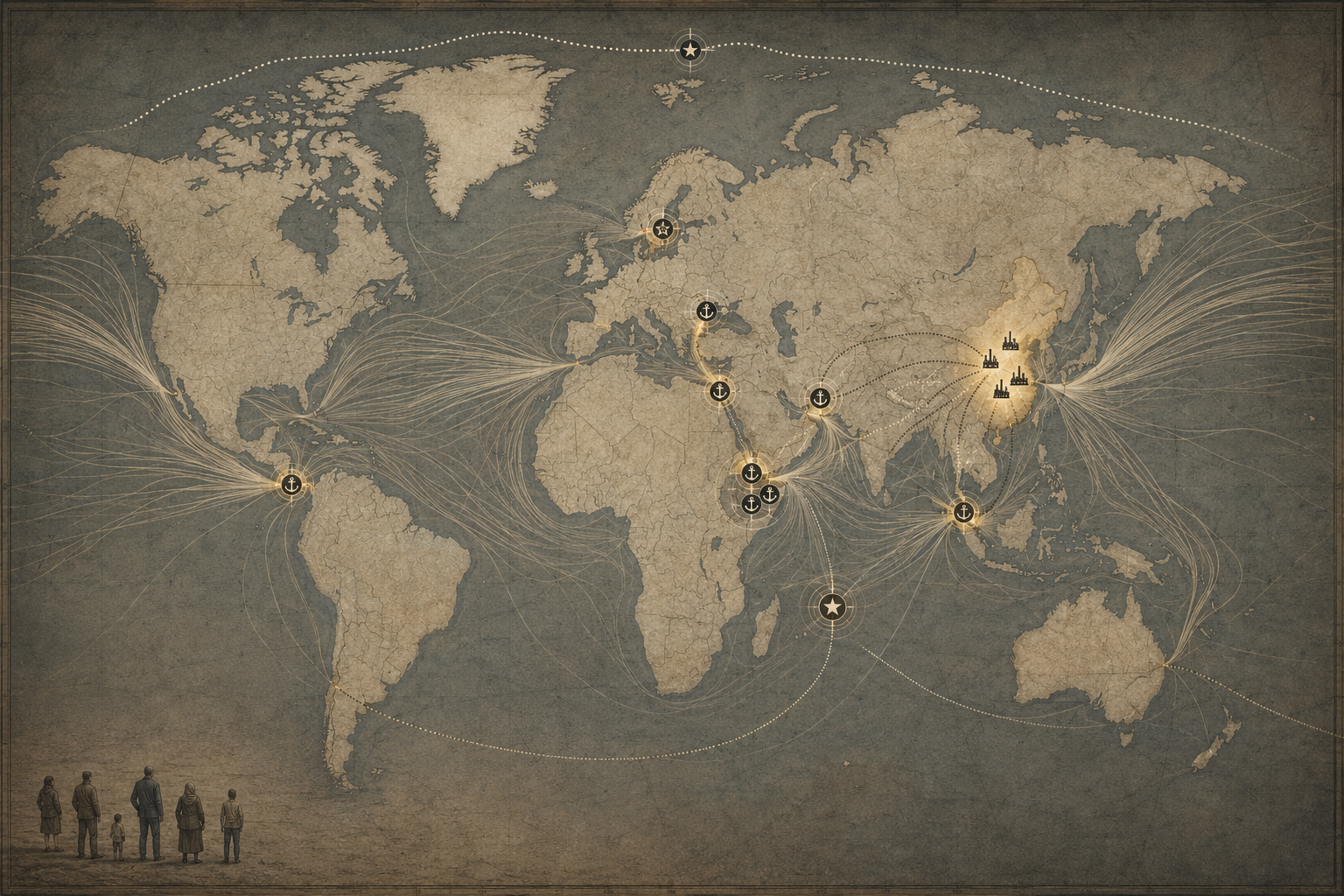
A world map in the muted, slightly aged style of an old commercial atlas, deep greys and warm parchment tones, no bright colours. The landmasses are plain and understated, deliberately unremarkable. The eye is drawn instead to the chokepoints: a handful of narrow sea passages marked with subtle bright constrictions, like a ribbon pinched between two fingers, at the Strait of Hormuz, the Strait of Malacca, Bab-el-Mandeb and Suez, the Panama Canal, the Danish and Turkish straits. Thin flowing lines of shipping traffic stream across the oceans and visibly bunch and narrow as they squeeze through each pinch point, thick and tangled at the straits, thin elsewhere. At several of these pinch points sits a small, discreet military marker, a simple anchor or star symbol with a faint defensive ring around it, showing a base or fleet holding the passage: one at Hormuz, one in the middle of the Indian Ocean at Diego Garcia, one at the mouth of Bab-el-Mandeb near the Horn of Africa where several such markers cluster together uneasily, one at Panama. Over the landmass of China, a different marker: not a passage but a cluster of small refinery and smelter symbols glowing faintly, with dispersed thin ore-lines from Africa, South America and Australia all converging into that single cluster, showing the scattered sources funnelling into one processing hub. Across the Arctic top of the map, a faint dotted route curves over the pole, bypassing the pinch points below, marked discreetly as the northern passage, with a single marker of its own. In one corner, almost incidental, a few small human figures rendered very small and plain, standing apart from the grand map, suggesting the people downstream of the passages who never appear on it.

The map is mostly bottlenecks

The usual way of reading the contest over resources is to look at where they are. Whose ground holds the oil, the gas, the rare earths, the cobalt. On that picture power follows the deposit, and the country sitting on the richest seam holds the strongest hand. It is the picture behind a great deal of the current talk a…

June 7, 2026 · 12 min

The Dealer smiles?

We are told that world politics is a chess game. Grandmasters move pieces across a board, sacrificing pawns to protect kings, calculating six moves ahead. It is rational. It is elegant. It is, above all, knowable. This is a lie. After walking through the resource wars of Venezuela, Greenland, Iran, Ukraine, Russia and …

May 1, 2026 · 10 min
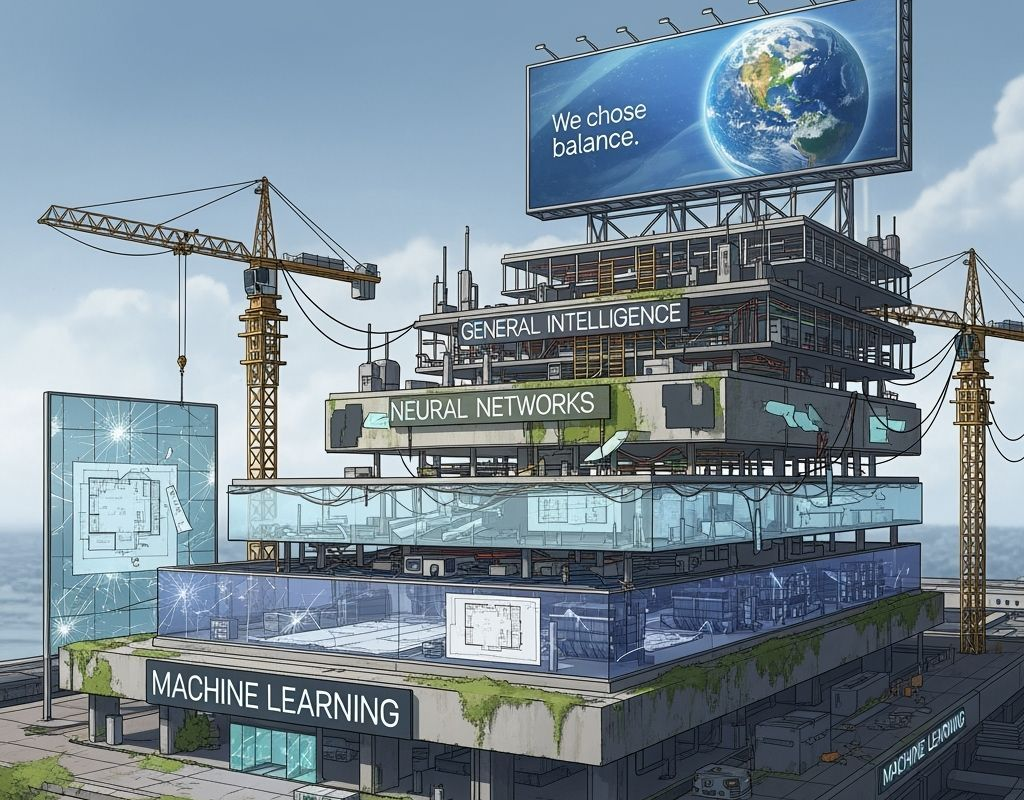
A futuristic building in the shape of a data stack, with each layer representing a halted phase of AI development: machine learning, neural networks, general intelligence. Each level more incomplete than the last. Signs of abandonment, cranes frozen mid-air, architectural plans strewn across a cracked smart glass wall. Above, a billboard shows a serene Earth with the slogan: “We chose balance.

The Great Pullback (best case)

It is fashionable to believe that technological progress is inevitable, and that artificial intelligence will, barring catastrophe, continue its relentless march forward. But there is a future, quietly lurking just beyond the smug grins of Silicon Valley keynote speeches, where AI does not progress much further at all.…

July 21, 2025 · 4 min

The European Democracy Shield: Noble crusade or bureaucratic cosplay?

The European Democracy Shield (EUDS), a name that practically screams “importance”, if not effectiveness. One imagines a shining bulwark of European resolve, standing firm against the onslaught of foreign interference, disinformation, and creeping authoritarianism. In practice, though, we might be dealing with somethin…

July 2, 2025 · 5 min

The true cost of cutting costs

This cheerful little analysis explores how Europe’s recent budget-slashing spree is playing out, cutting aid, climate finance, health, and all those other inconvenient things that don’t explode or vote. The immediate fallout (spoiler: it’s not great), the long-term consequences (even less great), and how all these “fis…

June 16, 2025 · 10 min

The calculated chaos behind Israel's strike on Iran

Why did Israel really attack Iran? Analysis with wit and additional perspectives by PR included. Israel’s recent strikes on Iran mark a dramatic escalation in a decades-long shadow war that has finally emerged from the shadows, rather like a pensioner suddenly taking up parkour. The reasons behind this attack weave tog…

June 13, 2025 · 8 min
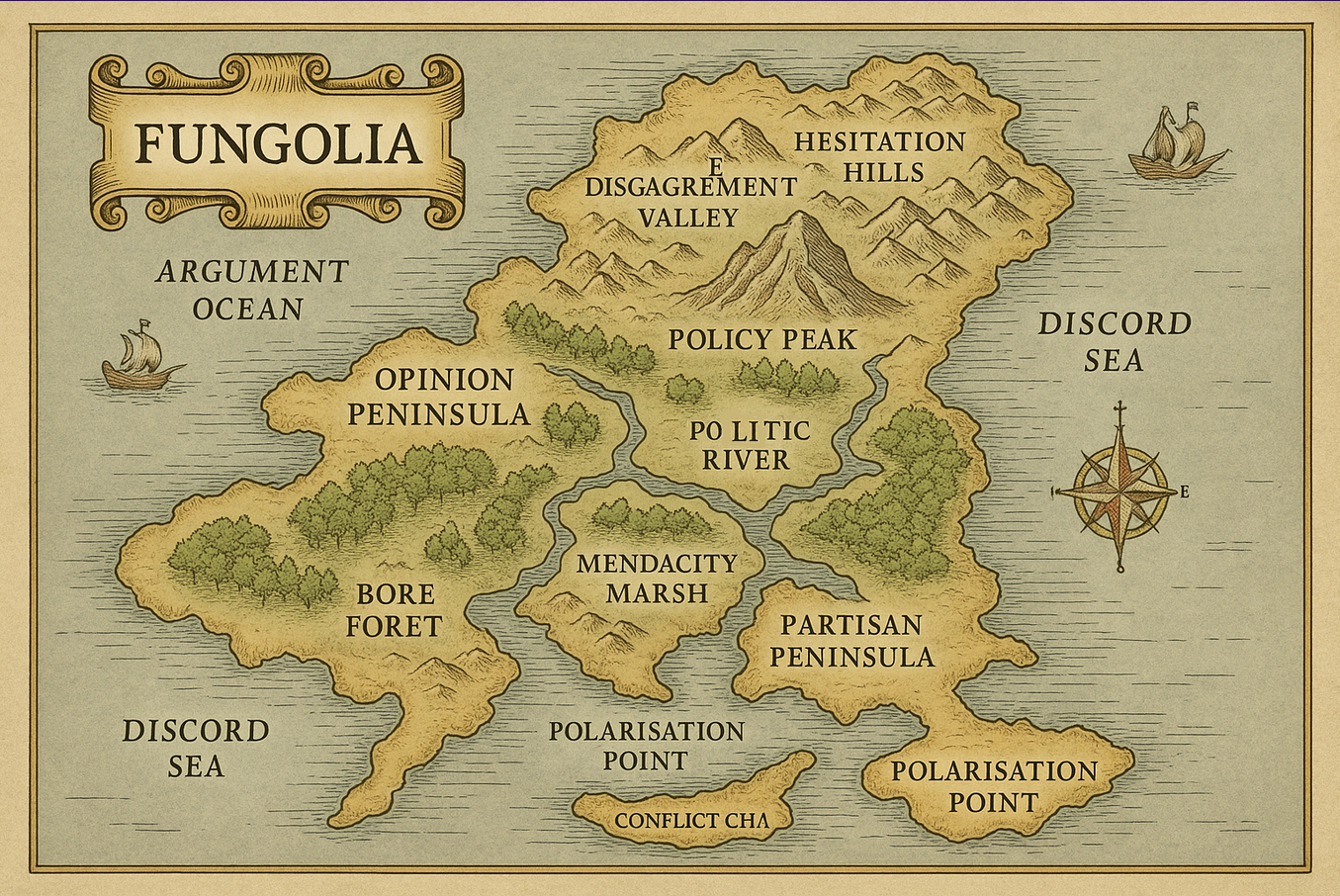
An illustrated map of Fungolia: Complete with absurd regions like 'Disagreement Valley' and 'Policy Plateau', styled like a medieval map but with modern satire.

United we stand (or at least, we could)

Welcome to Fungolia, a fictional European nation best known for producing bureaucrats with severe stationery addictions, national holidays dedicated to committee meetings, and the invention of the “Mutually Suspicious Cooperation Accord” ( which mostly involved not poisoning each other’s water supply). In Fungolia, dif…

June 4, 2025 · 6 min
A solitary broomstick against a worn concrete wall

About the Broomstick

About the Broomstick Welcome to The Broomstick Brief, a blog for those who suspect that the world isn’t quite as rational, peaceful, or democratic as advertised. This is a space for untangling complexity, lifting the curtain on technocratic waffle, and occasionally poking polite fun at the collapsing scaffolding of lat…

June 2, 2025 · 2 min