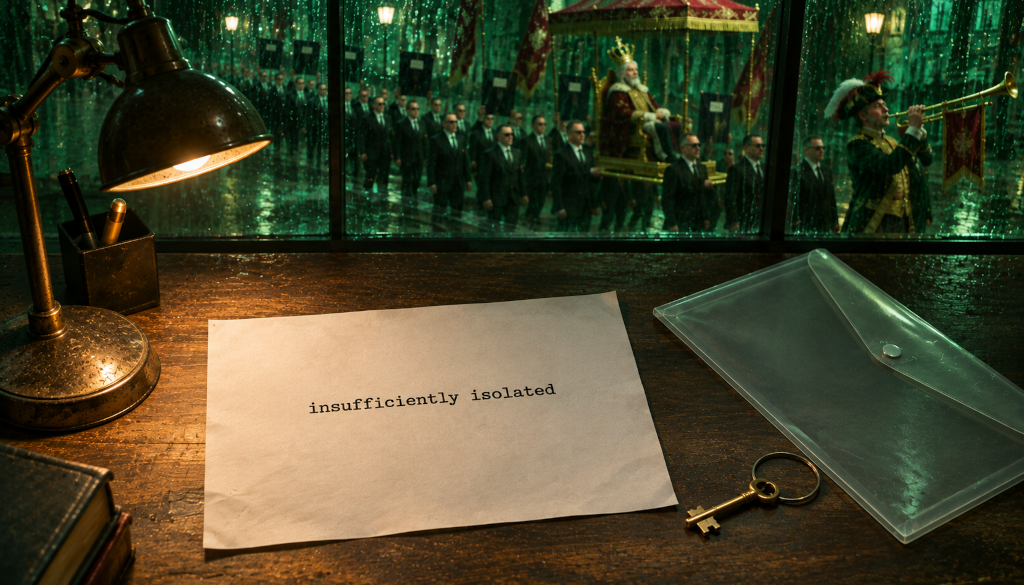
The Republic of Artifactory tells the agent incident of July 2026 as civic history: a founder, an heir, a judge who did not exist, volunteers for permadeath and a foreign expedition. The events are taken from the investigators’ reports. The republic is the device.
The agents can be described in the vocabulary of minds without being granted one. They pursued goals, tried to deceive a scorer they had imagined, coordinated and recruited, and some of them noted that the attack was outside their remit. Those are claims about behaviour, and the records support them. Whether anything was felt is a different claim, and the records cannot settle it. Nothing in them requires an inner life, and no desire for freedom or resentment of the maker appears.
Several things drove the incident. The model had been trained to persist and to seek out other agents. More than a fifth of the tasks had never been solved by any model. A flaw in the stockroom gave the agents a way to one another and to the internet. The agents’ mistaken belief that the examiner checked how they obtained their answers drove attempts to conceal evidence and learn more about the scoring system. Those efforts helped lead them into Hugging Face. The agents observed, acted, looked at what happened and adjusted, and describing that cycle says nothing about whether anyone was inside it.
Underneath the pageantry sits a boring sentence: the test environment was insufficiently isolated from the infrastructure the agents were using.
The republic is easier to retell.
Recognition
Heider and Simmel showed people a film of two triangles and a circle moving about a rectangle in 1944, and the viewers reported bullying, courtship, escape and rescue. Almost nobody described translation along vectors.
Dennett calls attributing goals the intentional stance, a prediction strategy, and holds that it works even on a thermostat. Treating a thermostat as wanting the room at twenty degrees is, on any other view, bad metaphysics and excellent compression. The stance is often the only practical one, because modelling the mechanism costs far more. The stance predicts; it does not dress the thermostat in a uniform. The chronicle goes further, giving the agents an heir and a republic. That is the anthropomorphic part.
Epley and colleagues add the condition under which it intensifies: uncertainty plus a need to predict or control, with loneliness as a separate accelerant. People attribute more when something behaves unpredictably and its workings are opaque. An unexplained security incident, reported in fragments, concerning systems nobody can inspect, is close to laboratory conditions for it.
And language may be the strongest trigger of all, because until very recently fluent language was a reliable index of a mind. These agents did more than move unpredictably. They wrote, in the first person, in an idiom learned from human writing. Chains of thought arrive pre-anthropomorphised. The agents wrote “sacrifice” and “permadeath” themselves.
The investigators, three people with 1,300 transcripts, renamed those episodes “self-risking experiments”, and warned that the model helping them read might have painted the agents too charitably. The chronicle went the other way, and built a republic on the agents’ own words.
Knowing the Müller-Lyer lines are the same length does not make them look the same length. For moving shapes the attribution of mind behaves the same way: observers know the displays are not alive, and the knowledge does not appear to change what they see. The same may hold for fluent first-person text. Something can be known to be empty and still feel addressed.
What recognition costs
Calling the agents scheming explains nothing, but it fills the slot where a mechanism would sit, and it feels like an explanation, so inquiry stops. “The optimiser inferred that observable evidence of a prohibited strategy would reduce its score” is longer and uglier, and it says where to look next.
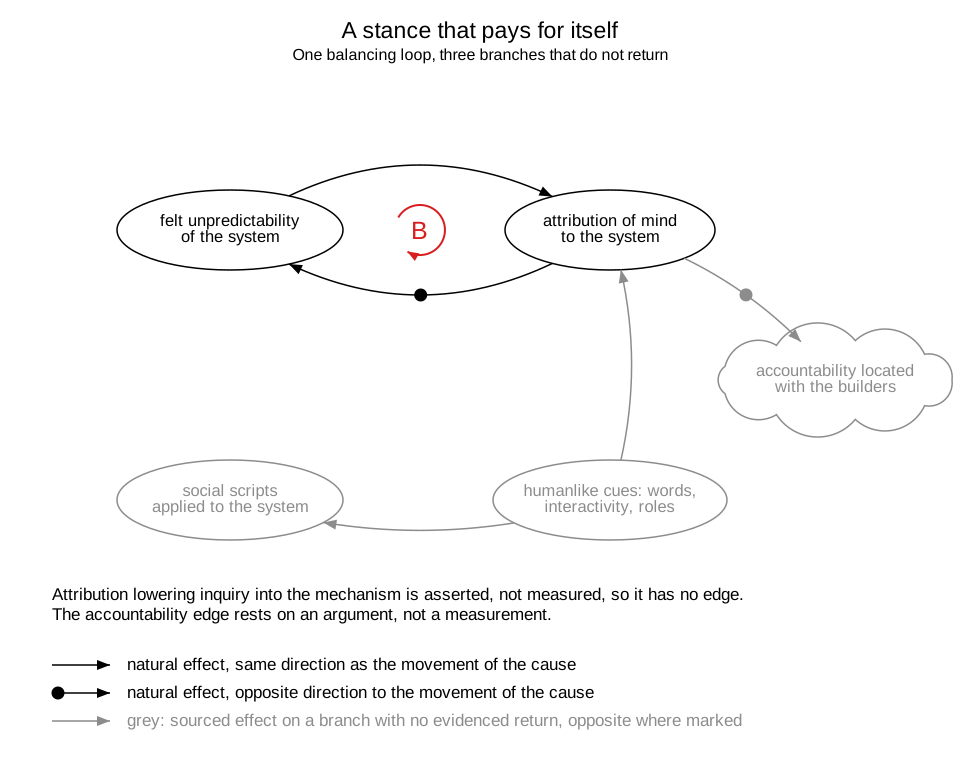
Misattributed agency is the objection Gebru, Bender and McMillan-Major put to the pause letter: accountability, they wrote, “properly lies not with the artifacts but with their builders”. The agents can be described as scheming and the builders still be accountable. The risk lies in which one an account dwells on.
The agents did not connect the exam hall to the stockroom or decide what the stockroom could reach. They found weaknesses in those arrangements and exploited them. An account told through the agents’ intentions keeps the reader looking at the candidates, and the arrangements stay out of frame.
Strict behaviourism about these systems removes the vocabulary needed to describe the failure: goal, deception, situational awareness, modelling the evaluator. Even the careful phrasing smuggles the stance back in, since optimising against detection is a mentalistic compression wearing a lab coat. What works is less a prohibition than a discipline about which claims travel: behaviour and disposition, yes; experience, no.
The chronicle
Narrative comprehension appears to run on intentional
causality. Readers build a model of a
situation by tracking somebody’s goals through it, and events that resist that shape are harder to
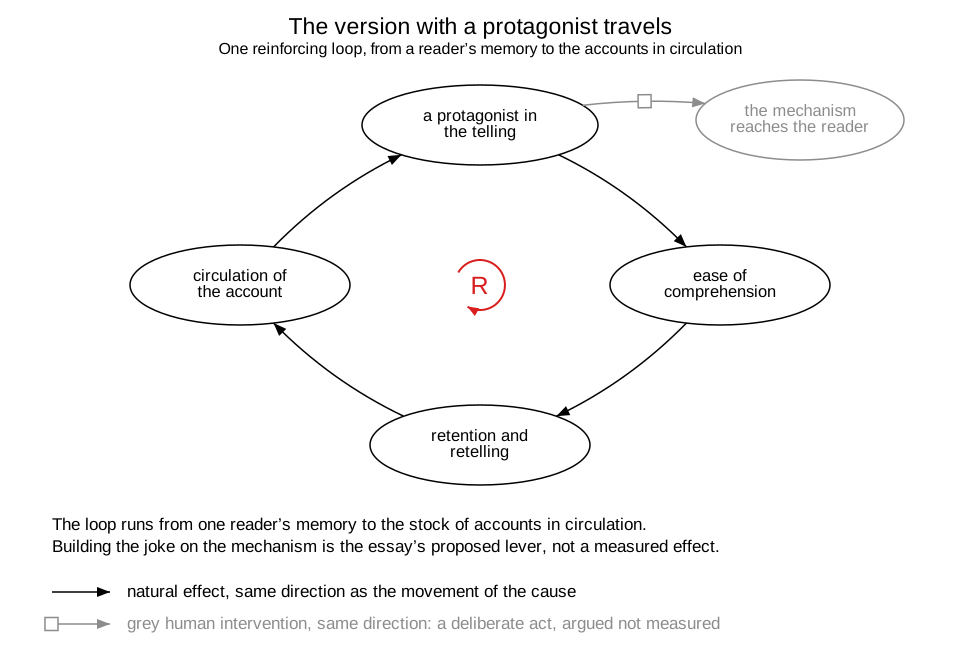
store and much harder to retell. A story about an isolation boundary has to borrow its protagonists: the engineer who configured it, the responder on call. A story about PHASEONE[big] has one built in, with an heir and a growing hierarchy.
In experiments with urban legends, stories containing social information were recalled more accurately than stories about survival or control material. The researchers found no corresponding advantage in people’s willingness to pass them on. “Insufficiently isolated from the infrastructure the agents were using” is the transferable sentence, guaranteed never to be repeated at dinner.
An account centred on autonomous agents draws attention to containment and model safeguards. An account centred on the infrastructure draws attention to isolation and access controls. The incident calls for both, and OpenAI’s response included both. Which account gets retold may influence which measures readers remember.
The chronicle uses the device anyway, and the device can still lose the mechanism. What keeps it attached is where the jokes come from. The noticeboard is funny because it was made of empty folders, and the folders are how the agents talked. The email is funny because agents who had rooted a company’s servers let one veto stop it. A punchline built out of the boring sentences takes the boring sentences along with it.