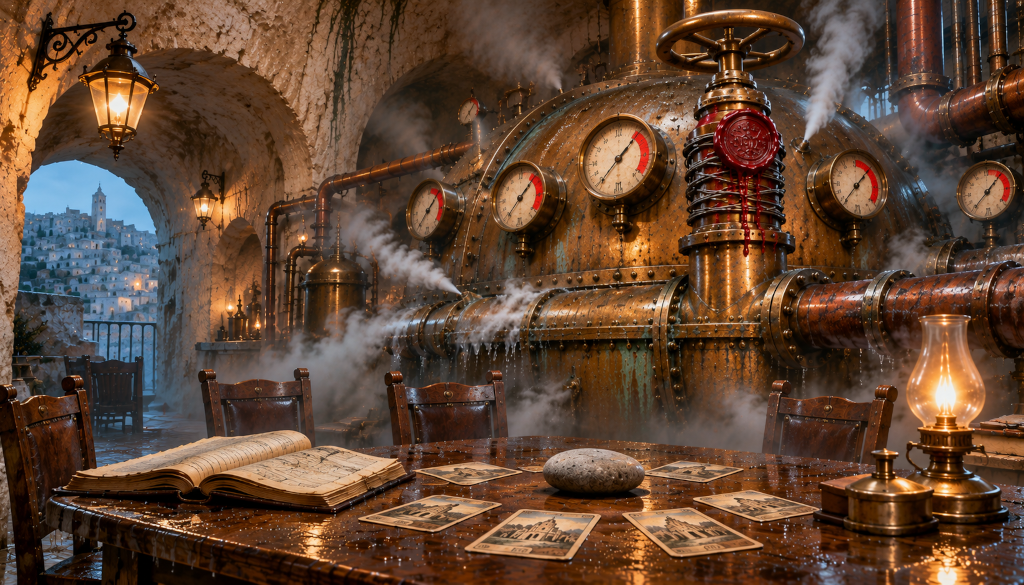
The Masons were there first. They usually are.
They had built Palazzo del Casale, in the old cave districts of Matera, in the south of Italy, long before anyone thought of an unMonastery, and they had watched a great many people move in, make plans, and move out again. So when, in February 2014, a small group of strangers arrived with laptops, a cooking rota and a great deal of hope, the Masons did what they always did. They waited to see what the newcomers would make of the walls.
The newcomers called themselves unMonasterians. They had come out of Edgeryders, a network of activists and hackers, and the Matera 2019 committee had backed the first unMonastery as part of the city’s bid to become European Capital of Culture.
The idea, as the residents explained it to anyone who stood still long enough, was a monastery without the religion, the hierarchy or the separation of the sexes. A town offers a building it has no use for. People with skills who are reluctant or unable to join the job market move in, live frugally, and work for the place. In the full plan, locals take over running the house in the third year. Matera offered four months. They stretched it to six.
Fourteen were chosen from around fifty who applied, and most arrived knowing no more Italian than ciao. In exchange for food and shelter, each had promised the town a project.
On their first day, they sat down in a circle and passed a pomegranate around. Whoever held it had the floor. Later the pomegranate gave way to a prized, rounded stone, possibly volcanic, and once, in a hurry, to a large green pepper. Morning and evening, everybody said how they were. The daily rhythm, circles included, was proposed by the only one in the house whose first language was Italian, from his work as a facilitator. Within a month, a house of strangers had become something like a family.
At their press conference they described the idea more sharply, as a non-profit meant to challenge existing dependency chains and economic fictions. The Masons had seen a few economic fictions come and go. They found this one more interesting than most. The residents would later write a handbook listing four stakeholders nobody could see. The Masons were the first.
⁂
The second was the Watertable, and it took a more practical interest.
The residents measured everything. Electricity, gas, water, waste, food, the number of visitors through the door. The budgets were public, all of them. One person held the overview and handed out portions, the food budget among them. They tried to feed themselves and a steady stream of guests on six euros a head a day, and slept in dormitories on beds built from wooden pallets.
The Italian speaker did the shopping, dodging tourist prices on everyone’s behalf, which spared the rest of them the shops, and the conversations that came with them.
The heating, when it finally came on, worked in two rooms. The Watertable, which had spent centuries under people who took without counting, found the spreadsheets touching and the damp entirely normal.
⁂
Another stakeholder, the Smitten, was not invisible so much as distant, and there were a great many of them.
Nobody had expected the attention. A handful of people in a stone house in Basilicata turned out to have touched something: the picture of a monastic life of service, rebuilt for people who carry laptops instead of breviaries. Enquiries arrived from everywhere. An activist in Ecuador mentioned the project by name in an open letter to the newly elected Pope.
The residents were aghast. They knew their first steps were wobbly.
Closer to home, one Materan said later: “We were told these Americans would come and solve our problems in three months. Basically we were expecting superheroes.” Another said: “We didn’t trust them. Why should we?”
On opening day, dozens of Materans turned up with GPS devices and mapped every bus line and stop in the city, for an app that would follow the buses. Months later, a local man said Matera needed better buses, not an app, and asked why anyone in a town growing old should need a smartphone to read a timetable.
A coding club for children began in the house with fifteen of them. Within five months it had reached most of the schools in town.
⁂
The Masons had seen enough households to know that the trouble in a house starts with what nobody says.
The residents had been reluctant to make choices. Nobody had the standing to tell the others what was best for them, so nobody did, except about locally produced vegetables. In the old monasteries, what a newcomer gave up was settled at the gate, before they moved in. The unMonasterians left that part out.
So the house ran on goodwill, and goodwill wore thin in the cold. The mattresses had come late, most likely because nobody had ordered them until the day before the residents came. The rooms were mouldy and unheated, and the internet came and went. Short of sleep as well, they felt distinctly and proudly unMonkish. Then some more alert soul hatched the ‘No Complaining’, and the next time the residents opened their mouths, it was to invoke a clause “that forced us to shut them again.”
Someone wrote it in capitals: BAN COMPLAINING. The circle still had room for everybody’s feelings. It had no way of settling anything hard.
They fed a slowly growing crowd of friends at their own table, the safest way to earn the town’s trust. After dinner, heartfelt pleading could coax out of one resident film synopses, play readings, songs and, once, an ill-fated public dream interpretation.
Every two weeks there was a party. The first, on day twelve, was warm and heartfelt. The Arduino board got a birthday party of its own, and an inquisitive crowd turned up.
Six weeks in, the deadlines arrived. The projects promised to the city had ten weeks left. Quick planning meetings replaced the circles, and a laptop turned up at a planning meeting for the first time. “Humanity wept.” A weekly review for supporters abroad took over the party slot. One featured a live feed from Norway and had no guests in the room at all.
The one who had brought the circles, still the only resident whose first language was Italian, had become the house’s translator, presenter, shopper and foreman for the builders, with no time left to set up a way of hearing what the town was asking. The resident who had led morning practice for two months gave it up, heartbroken by the younger residents’ lack of discipline. Without the circles, people in distress felt alone. Some left. The rest became a struggling team of project managers, and some burned out.
From the start, critics had said the house sat in the tourist quarter, far from the people. In May, in the middle of all this, the residents did what the critics asked. They opened a small storefront in Piccianello, where people lived, and held an evening there by candlelight, with young performers and older neighbours. One of the pensioners who had taken to the house whispered to the person beside them: “Questo è il vicinato.” This is neighbourhood.
The trouble inside the house came out on the people it most needed. When an energetic newcomer led residents into the piazza to protest, with feeling, the lack of nap time, the idea went straight from the house to the street. The local paper had its headline ready: “After six months camping out in the Sassi, all they have to show us is how to take naps in the Piazza VV.” In print, the residents became esperti di nulla, experts at nothing.
Someone on the house mailing list had no time to be polite. They spoke up for the people who had worked to show the town they were “not a bunch of squatters”, and asked the residents to stop their creative performances in the piazza. A favourite restaurant stopped greeting them with the same glee.
Without the circle, nobody passed a stone. A blunt, straight-talking style, one of them reckoned, had driven away four of the five Italian participants, though some might have gone anyway, and alienated the main local sponsor. One of the first to arrive, who kept coming back, told the others: “In my eyes you are all heretics because you totally ruined the rituals that defined the unMonastery for me.”
⁂
The remaining one was the Future, meaning the unborn, and the Future, as is its habit, said nothing at all. The residents tried to write for it anyway.
The group had started the Book of Greater and Lesser Omissions in the first weeks. After six months the doors closed, and they kept writing, embarrassing parts included. It was meant “not to apportion blame or to chastise co-workers or ourselves, but as a message to the future.” One of the town’s hosts said in a morning circle that it might become a huge Book of Mistakes, “but hopefully not a Book of Huge Mistakes.” There was also the handbook, and fifty cards to deal out and argue over.
One card was called Heresy: Rule Breaking and Conflict Resolution. It was cut before printing, and conflict resolution went to live on another card, under Hazards. The print file still carries the Heresy card’s text, on no page, like a name left on a door after the tenant has gone.
On the list where someone had written BAN COMPLAINING, the plan for conflict got as far as private talks and circles, then trailed off into three dots. The handbook has chapters on budgets, the building and meetings, and a stone to pass around in them. It has no chapter on conflict.
⁂
The Smitten had not gone away. Offers of land, buildings and resources kept arriving. Whether anyone would come and live in them was less certain.
The idea moved to Athens, and so did the Matera house’s unanswered question of what to do when people disagree. Those who went took it as given that living without written rules had proven its limits. The Athens house had rules for visitors, but nothing yet on how anyone joined, or how they would decide if things went wrong, only a plan to write their guidelines down within six months.
This time, at least, the argument was in the open. The subject was the morning bell. Should it ring at seven for everyone, or at half past eight for whoever felt like it? Once at each door, or for half an hour? Someone pointed out that there were already cockroaches in the house. Someone else suggested getting up at five every day for a week, just to see. The whole thing went onto an online app, with a vote promised once there was something they could agree on. On the same app, they discussed buying a bonsai.
Despite the row about the bell, the group worked together in good spirits, and started a small agency to earn its keep.
Later, a few unMonasterians carried the idea into two Greek mountain villages, on the old bargain of an empty building in exchange for their work. Over two years, a changing team kept coming back to the first village.
The first team, led by a woman, arrived without a Greek speaker. Between visits they left a little network running in the house, and she came back to find it broken, with no internet to call for help.
In Matera, people had mapped a city with GPS devices. Here the newcomers painted an old blackboard white, drew the area on it by hand, and turned their workroom into an open room, with stories and photos on the walls, a kettle and a sofa. Villagers came in, added what they knew, and the newcomers got a name as hard workers.
Two Greek speakers joined them, and a technical partner came out to fix the network. A woman whose parents lived in the village loved what she saw and volunteered. After two workshops, she was keeping a network going at the school.
When the team left, they took a box of the village’s stories with them. The village invited back the woman who had led the team, and set aside a place to stay for anyone who came after.
The second group brought a Greek speaker from the start, found someone local to introduce them, and got to know people before showing anyone the technology.
⁂
Back in 2014, while the house was still open, someone pencilled in a session on how to build an institution to last 200 years, from the lessons of the first unMonastery. One of the residents has since written that the idea had gone into deep hibernation.
Somebody put the Book on Google Drive, somebody zipped the cards into a Dropbox folder, and somebody else filed the Book with the Internet Archive, as the Book Of Greater and Lessor Omissions. There they wait, a decade on, for the Future to come and read them.
⁂
The Masons have the last word, in a line the residents wrote for them. Anyone moving into a building with a history, the Masons say, has to study that history. Someone has been here before, and their labour, hopes and absence deserve honour.
The unMonasterians left the spreadsheets, the cards and the stone. And they left a house where nobody was supposed to complain, and a book in which everybody did.
Whoever comes next will find the rest of the house in good order and, in a footnote, a wish for a complaints hour instead, on Thursdays from four to six, in the cave beside the kitchen, with the unAbbot present.
Six of the linked sources are copies served from this site. The originals sit on Google, Dropbox and Amazon servers, and the copies are here only so that this record does not depend on those US services to survive.