
On 30 September 2008 the Irish government guaranteed six of its banks. By the next morning, the price of insuring against those banks’ default had fallen from roughly 400 basis points to 150. The price of insuring against Ireland’s own default went the other way: it quadrupled to over 100 basis points within a month and reached 400 within six. The risk of the Irish financial sector had been substantially transferred to the government’s balance sheet.
Transferred is the precise word. Nothing was removed. The banks’ risk moved to the state, and the state’s balance sheet was, to a considerable extent, held by the banks. The two exposures were not of the same kind: the state had taken on the banks’ possible losses as a liability, while the banks held the state’s debt as an asset. But each now depended more heavily on the other’s ability to pay.
A rescue that makes the debt ratio count
What the Irish case showed in one country, the European data showed across many. Before the autumn 2008 bailouts, there was almost no relationship across European countries between a government’s debt ratio and the market price of its default risk. After them, the relationship was strong and positive. A debt ratio that markets had treated as background became, within weeks, something they priced.
The return path runs through bank balance sheets. Euro area banks hold large amounts of government debt, and a disproportionate share of it has been their own government’s. When the sovereign’s credit risk rises, those bonds lose value, which eats into the banks’ capital.
Separately, the implicit promise that the state will support its banks is worth less, because the promise is only as good as the state making it, and the banks’ own credit risk rises with it. After the bailouts, a 10% rise in a sovereign’s credit default swap spread went with roughly a 0.9% rise in its banks’ spreads; before them, there was no such feedback.
The banks held so much of it for several reasons at once. Regulation treats exposures to euro area governments in their own currency as carrying a zero risk weight, so holding them costs no risk-based capital.
Governments also appear to have leaned on their banks. During the crisis, domestic banks in fiscally stressed countries were considerably more likely than foreign banks to add to their holdings of home bonds in exactly the months when their government had large amounts of debt to roll over. The pattern was strongest among banks that had received government support, small banks and banks with weaker balance sheets.
Banks themselves name political pressure, their business models and the perception of home bonds as safe and highly liquid, and when domestic bonds look attractive the leverage ratio is the only regulatory barrier to holding a great many of them.
The cost of that arrangement shows up when the sovereign stumbles. Government defaults are followed by falls in private credit, and the falls are larger where banks hold more government debt. A sovereign in trouble is also, through its banks, a squeeze on lending to everyone else.
A currency nobody in the room controls
Why the spiral bit so hard in the euro area and not elsewhere shows in a comparison of Spain and the United Kingdom in 2011. The UK had a higher debt ratio, around 89% of GDP against Spain’s 72%, yet Spain paid about 200 basis points more to borrow. The difference was not simply the size of the debt; it was also the currency it was written in.
Members of a monetary union issue debt in a currency over which they have no control. A government borrowing in a currency its own central bank issues can always be supplied with the cash to pay bondholders at maturity. A euro area government cannot count on that, and markets know it.
That opens the door to self-fulfilling crises. Investors who fear a default demand higher yields; higher yields make the debt harder to carry; the liquidity crisis turns into a solvency crisis. The fear can produce its own justification. The remedy, on this reading, is a lender of last resort in the government bond market: a central bank willing to buy without limit, so that a run has nothing to win.
The ECB came to that role in stages. From May 2010 its Securities Markets Programme bought government bonds, sterilised week by week and without a volume announced in advance, but framed as a repair for malfunctioning markets rather than a commitment.
On 6 September 2012 it replaced the programme with Outright Monetary Transactions, for which “ no ex ante quantitative limits are set“. The purchases were conditional on the country accepting a rescue programme from the European Stability Mechanism, with its conditions attached. OMT was never activated, in part because fiscally fragile governments were reluctant to submit to its conditions.
The announcement appears to have been enough. Much of the surge in peripheral spreads in 2010 and 2011 had been disconnected from debt ratios and fiscal space and tied to self-fulfilling negative sentiment. Once the commitment was in view, Spain’s two-year yield fell from 6.9% in late July 2012 to below 3% by early September without a bond being bought, and the contagion running from Spain to other sovereigns dissipated after the announcement.
In July 2022 the ECB added the Transmission Protection Instrument, to counter “unwarranted, disorderly market dynamics” in a member state’s bond market. Its activation depends on four cumulative criteria, among them that the country is not subject to an excessive deficit procedure and that its public debt is judged sustainable.
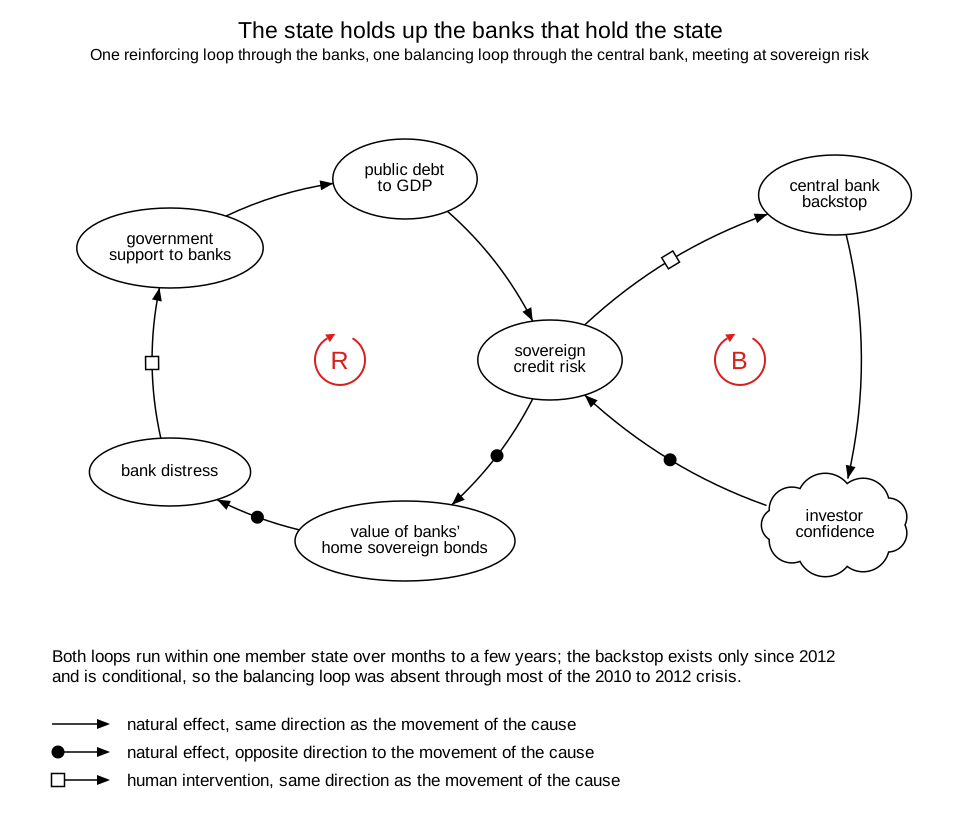
The spiral and the central bank’s promise meet at one price, the market’s price of a member state’s default. The spiral is slow: it waits on bank balance sheets and a national budget, months to a few years, each worsening preparing the next. The promise is fast, because belief is enough: an announcement moved spreads in 2012 before a single bond was bought.
Each turns on a decision. A government chooses to support its banks, and a central bank chooses to stand behind a government’s bonds. Neither choice is automatic, and the second one comes with conditions.
Where the backstop is weakest
The conditions are where the spiral and the promise stop being a match for each other. The spiral runs fastest in a country whose debt ratio is already high and rising. On a plain reading of the criteria, a country in that position is the one most likely to be under an excessive deficit procedure, or to have its debt path judged unsustainable. That makes it the one least likely to qualify for the instrument meant to calm its bond market.
Under OMT the same country would first have to accept a programme, and fiscally fragile governments proved reluctant to submit to such conditions. The worse a sovereign’s position becomes, the harder the conditions attached to its rescue are to meet, so the backstop weakens from within as the need for it grows. The promise holds in principle everywhere and in practice most reliably where it is least needed.
This is not necessarily a design error. A backstop without conditions invites the moral hazard its critics have long identified, and the ECB’s mandate is price stability, not the solvency of any particular treasury. But it leaves the spiral with an exit that narrows as the spiral speeds up.
What has moved since
Parts of the spiral are weaker than in 2010. The domestic share of euro area banks’ sovereign bond holdings fell from 39% in 2014 to around 28% at the end of 2025. Banks’ sovereign holdings stand at about 170% of their core equity capital, against 190% in 2014, while remaining roughly 9% of total assets; risk-based capital ratios have nearly doubled since the financial crisis. More capital does not stop losses on government bonds from weakening a bank, but it widens the cushion the loss has to cross.
The rescue has moved less than the balance sheets. Bail-in now puts shareholders and creditors ahead of taxpayers, but deposit insurance is still national. The European Deposit Insurance Scheme, proposed in November 2015 as the third pillar of banking union, has not been adopted. National deposit guarantee schemes keep the nexus alive, and it could re-emerge. As long as depositors in a member state look to that member state for their guarantee, the decision to rescue remains a national one, financed on a national balance sheet.
The proposals aimed at cutting the spiral outright have stayed proposals. It could be avoided if banks held only the senior tranche of a diversified portfolio of euro area bonds, the so-called ESBies, so that no bank’s balance sheet hung on its own government. Another route is pooling debt up to 60% of GDP in senior “blue” bonds. Both aim at the same thing, a bank’s holdings of its own government’s debt. Neither has been built.
Who pays, and who is paid
The spiral has a direction that its vocabulary of spreads and ratios hides. Run through a crisis, it pays those who lent to the banks and bills those who never did.
Ireland shows the route in its plainest form. The guarantee of September 2008 covered not only deposits but covered bonds, senior debt and dated subordinated debt; shareholders were left to lose, the senior creditors were made whole. When the Irish government wanted, in late 2010 and again in March 2011, to impose losses on senior bondholders, the ECB used the withdrawal of emergency liquidity as an explicit threat to prevent it.
That stance placed significant banking debts on the Irish citizen, inappropriately, and the refusal of burden sharing increased the overall cost of the crisis for the Irish people. Senior creditors were paid, and the state took on the cost, still put at a net figure of roughly €32 billion in 2025.
Greece shows the same transfer by a different route, and at a larger scale. Of about €216 billion lent in the first two programmes, less than 5% reached the Greek budget: the rest went to repaying and servicing existing debt, recapitalising Greek banks and paying private creditors to accept the 2012 restructuring.
Counting interest and bank recapitalisation as public spending, and adding money from outside the programmes, puts about half towards public expenditure instead, which renames the spending without redirecting it. What the loans bought was the continuity of payments to creditors.
What Greek households received was the adjustment attached as the condition: in the measures alone, before any cut to public services, the poorest tenth lost on average 8% of their incomes, and more than half of young people were without work by 2013.
The squeeze on credit sorts people the same way. A bank protecting its capital ratio after sovereign losses does it by restricting lending to firms and households. Households with wealth do not need the loan. Households without it do.
And the backstop steadies first what the richest hold. In the euro area about 80% of equities, fund shares and bonds belong to the wealthiest tenth of households, while the poorer half keeps around a quarter of its small wealth in bank deposits. A central bank standing behind the bond market steadies, first of all, the price of an asset held at the top; lower borrowing costs for the state reach everyone else second-hand, through the spending those costs allow.
The deposits of the poorer half rest on a guarantee that is still national, and so dependent on “the credit standing of the home sovereign”. Where the state is strong, the guarantee is strong. Where the state is caught in the spiral, so are the savings.
The drift since the crisis runs partly against this. Resolution rules now require shareholders and creditors to absorb losses first, rather than taxpayers. In Cyprus in 2013, where 47.5% of uninsured deposits at Bank of Cyprus were converted into equity while deposits under €100,000 were untouched, the loss stayed with those above the line.
But bail-in reaches only the direct route from a bank to the budget. The indirect routes, through lending, austerity and a deposit guarantee tied to its own state, still end at households, and they end hardest in the member states where the backstop is thinnest. The same euro does not carry the same protection everywhere it is held, nor the same bill.
The denominator
Every turn of the spiral passes through one quantity that is a ratio: public debt to GDP. The spiral can be slowed at the numerator, with smaller rescues, more bank capital and less home debt, which is where most of the reform effort since 2012 has gone. It can also be slowed at the denominator. A growing economy shrinks a debt ratio without anyone deciding anything.
That is where the spiral reaches past banks and budgets into the wider economy. Weakened banks lend less; less lending means less investment and slower growth; slower growth raises the ratio at the centre of the spiral. Nobody decides anything along that path.
The spiral between states and banks appears to be, underneath, also a question of growth. A monetary union whose members cannot print their own currency, whose banks hold their own governments, and whose central bank stands behind the bond market on conditions, may depend on growth to keep the arithmetic quiet rather more than its fiscal rules admit.