The organisation without a model of itself

In March a new starter sat for a week without a login. Six people met four times and recommended a pre-start checklist. The checklist was adopted. In September a new starter sat for a week without a login. The March report named three causes: unclear ownership of onboarding, a communication gap between IT and HR, and a…
August 5, 2026 · 3 min

Why maturity models disappoint

The assessors came for three days in October. The evidence pack ran to 412 documents, 61 of them written that fortnight. The verdict was level three of five, with a roadmap to level four. The certificate hangs by the lift. In November a release went out without a rollback plan, the way releases had always gone out. Pol…

August 5, 2026 · 3 min

AI is exposing old organisational weaknesses

The assistant went live on a Tuesday, indexed the intranet, and was asked by somebody about to resign what notice period applies. It answered three months, quoting a policy page from 2019. The answer has been one month since the 2022 handbook. The pilot review recorded a hallucination. The model had not hallucinated. I…

August 5, 2026 · 3 min

Why intelligent people disagree while using exactly the same words

Four people leave a meeting agreed about the risk of moving payroll to a new provider in January. The minute says so, and none of them has reason to doubt it. In the room, the payroll manager meant the chance that the first run would come out wrong. Finance meant what it would cost to put right. Legal meant who would a…

August 5, 2026 · 4 min

Most organisations do not have an information problem

A familiar ritual follows organisational trouble. A decision goes wrong, a delivery slips, a risk materialises that somebody somewhere had documented, and the retrospective lands on a convenient conclusion: the information wasn’t good enough. The remedy writes itself. Another dashboard. A new report. A data lake, prope…

August 5, 2026 · 5 min
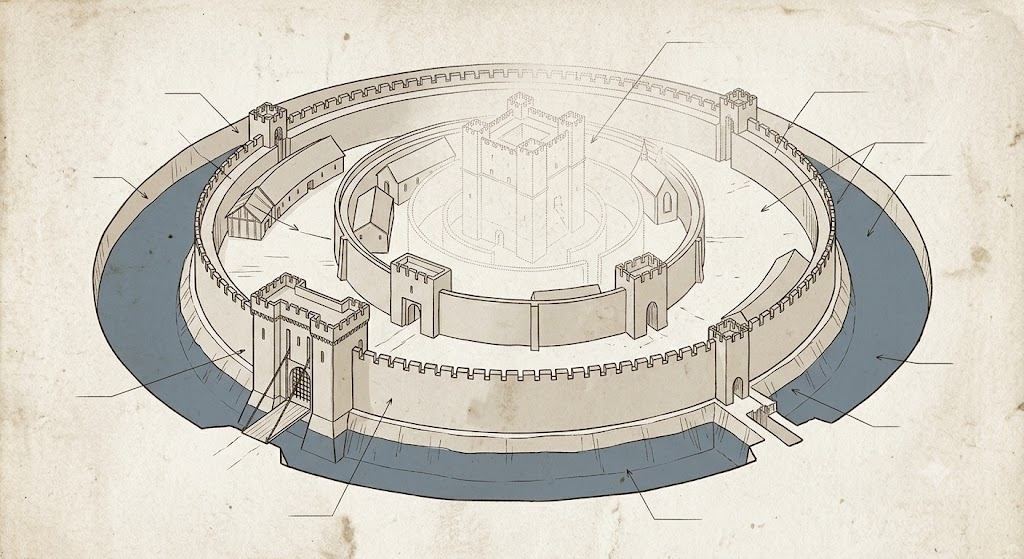
Cross-section illustration of a medieval castle's concentric defences seen from above at a slight angle: moat, outer wall, gatehouse, courtyard, inner keep

The phrase survived. The definition did not.

Consider a medieval castle. It is tempting to imagine that its security rested on the thickness of its walls, and that a besieging army faced essentially one problem, repeated: get past the stone. But that is not how a defended position worked, and the people who built them knew it. A castle was arranged so that every …

July 21, 2026 · 10 min
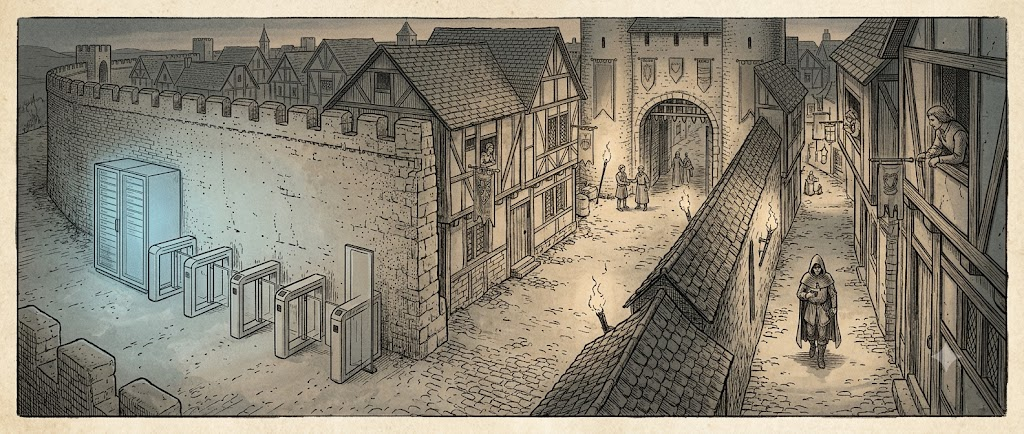
A walled medieval city at dusk seen from slightly above, gates standing open, lantern-lit lanes, guild banners hanging from timbered houses, small figures greeting one another at the gate and leaning from windows to watch a lone stranger in the lane. One long section of the city wall has been replaced by an incongruous row of sleek modern turnstiles and a faint blue-glowing server cabinet.

The trouble with calling it zero trust

A medieval city was never secured by its wall alone. It had guilds that vouched for their members, letters of introduction carried from town to town, gate guards who knew faces, innkeepers who noticed accents, and neighbours who registered a stranger in the lane before any official did. The wall was one instrument amon…

July 20, 2026 · 11 min

War follows the ground

Humans have probably always killed one another. Warfare is something narrower. It implies groups, planning, logistics, memory, leadership, and enough social organisation that violence stops being a personal act and becomes a collective institution. The interesting question is not when humans first killed. It is when ki…

July 16, 2026 · 20 min

Peace has running costs

Organised violence tends to appear where the substrate makes it the higher-return move, and to recede where it does not. That is one way to read the origins of war. Inverted, the same reading yields a second claim, less obvious and more useful. If war is what the ground rewards under some conditions, then peace is what…

July 16, 2026 · 9 min

The naming and the finding out

At eight in the evening on 31 August 1939, a small team in Polish uniforms seized a radio transmitter at Gleiwitz in Upper Silesia and broadcast a few minutes of anti-German agitation. By the following morning the event had a name, an author, and a consequence: a Polish provocation, answered by the invasion that began …

July 8, 2026 · 23 min